Boarding Pass for the Third Act: Travel as Praxis, Aging as Adventure
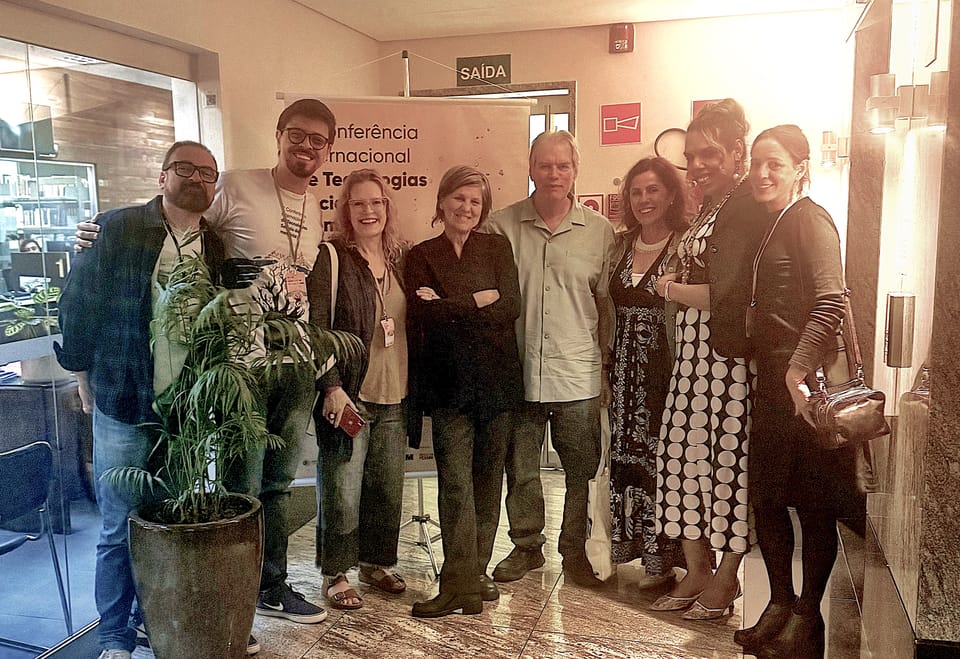
I write from Sao Paulo, Brazil. I find myself at the end of a two year odyssey to generate what became the 12th International Digital Storytelling Conference (and the first International Conference of Social Memory Technology, more on that later).
Of course, the week has been both emotional and inspiring, exhausting and exhilarating. Yesterday I spent the day walking around Sao Paulo with my son Massimo, and was reminded what happens when you skip the gym for 10 days, and spend far too much time in chairs. Sao Paulo has hills that test knees and lower backs. Stiff joints even makes it hard to get my legs out of cabs, and while I held my own on the dance floor, I was humbled by how much had changed in the 15 years since my last visit.
I was reminded of my earlier interview with Bill Randall. He reminded us to re-genre-ate the story of aging from tragedy to adventure, not as a denial of loss, but as a deepening of plot: outward, inward, backward, forward. Adventure, he says, begins where comfort ends, and old age is nothing if not an invitation beyond the familiar. journals.lib.unb.ca+1
Outward: The World as Classroom (and Commons)
Older adults who travel—whether across town to a riverside path or across oceans to a grandchild’s graduation—often report better mood, richer social ties, and measurable cognitive gains. Recent longitudinal and cross-sectional studies associate tourism and purposeful leisure trips with higher well-being and lower risks of cognitive decline; walking even a daily mile helps preserve brain volume in regions linked to memory. None of this is magical thinking; it’s dose-response common sense: movement, novelty, nature, and belonging keep minds plastic and hearts open. Verywell Health+3PMC+3PMC+3
The catch is equity. We can’t preach “adventure” while transit deserts, pricing, and ableist design keep millions homebound.
Adventure isn’t just a metaphor. It’s a set of actual journeys—by bus, by memory, by voice—through a world organized to speed some of us along and strand others at the curb. If we’re going to call aging an adventure, then we have to make the runway fair: accessible cities, affordable tickets, room for wheelchairs and walking sticks, time for slowness, and a culture that honors the stories elders carry. Let’s call that mobility justice, and it’s part of what turns a slogan into a social contract. UN Tourism, disability rights advocates, and healthy-longevity researchers have been saying the quiet part out loud: make travel accessible and we improve not just vacations, but health, economies, and the democratic imagination. European Parliament+3UN DESA+3Untourism+3
The “longevity economy” reports coming out of the EU and global coalitions are clear: older travelers are a powerhouse market—and a public-health opportunity—if we build ramps instead of barriers and see accessibility not as charity, but as infrastructure. That means tactile maps, captioned guides, lower steps on buses, slower itineraries, and staff trained to listen. It also means acknowledging that many “adventures” are micro-local: the weekly train to the beach, the slow loop around a city park, the community center’s museum day. Make those possible and you’ve widened the world. European Parliament+1
Inward: The Pilgrimage of Coherence
I think it is fair to say that how we story our aging shapes how we live it. When later life is framed only as decline, we speed toward narrative foreclosure—“the end of my plot is already written.” Flip the genre and something loosens. The adventure frame authorizes curiosity: what can I still learn, repair, give? What scenes deserve one more take?
For three decades in digital storytelling, I’ve watched that reframing move through people like weather. We gather in a circle, not to perform, but to listen each other into speech. We work from the inside-out: insight first, audience second.
This is not a luxury art. For many, it’s mental health work by another name: building narrative coherence, what Erikson called “accepting one’s one and only life cycle as something that had to be.” In later life, that acceptance doesn’t erase grief; it steadies it. And whether we’re working with a therapist, a friend, a story facilitator—or, yes, ethical AI prompts that help retrieve and organize memories—the point is the same: perspective-making as a daily practice of dignity.
Backward: Memory as a Place You Can Still Walk
Aging as adventure means time-travel, too—walking back through landscapes we’ve loved or lost. I felt that here in Sao Paulo, my fourth trip, but not only did the landscape change, but my relationship to the people, to neighborhoods, even sharing it with an adult son, meant this was new and familiar at the same time.
Narrative gerontology calls it “life review,” but the texture is simpler: a song that still knows the way home; a kitchen table that smells like Sundays; a street where your first march changed your spine.
Backwards doesn’t mean stuck. It means recognizing that artifacts of memory—the ones in our inds, or looking at our facebook images from the time before—have become a kind of ancestor temple in modern life. Our task is to tend that temple without turning it into a mausoleum. We’ve had countless travel tales in the StoryCenter (like this one, heavy with history, Bits and Pieces by Sue Wallingford), as journey evokes perspective. Those of us from the privileged contexts of consumer capitalist abundance crossing borders into dissimilar under-resourced environments, or simply from one language, one culture to another, looking at our own presumptions. Travel cracks us open and leaves us changed. As Mark Twain wrote, “Travel is fatal to prejudice, bigotry, and narrow-mindedness, and many of our people need it sorely on these accounts. Broad, wholesome, charitable views of men and things cannot be acquired by vegetating in one little corner of the earth all one's lifetime.”
Forward: Designing the Conditions for Everyone’s Adventure
I can imagine my future trips abroad will need to account for my bodies shift and limitations. So I am hopeful that moving forward means policy. If we want elders on adventures—inner and outer—we have to build the on-ramps.
- Accessibility by design. UN Tourism’s accessibility guidelines and “tourism for all” frameworks are not window dressing; they’re the blueprint. Destinations that implement them not only welcome disabled and older travelers; they improve quality of life for locals of all ages. This is universal design as civic love. webunwto.s3-eu-west-1.amazonaws.com+1
- Slow itineraries. Replace the checkbox tour with the linger: fewer stops, more depth, lots of benches. The research on senior tourism is converging: slower, culturally grounded experiences serve health and satisfaction better than speed. SAGE Journals+1
- Active transport. Sidewalks, safe crossings, shaded paths, and frequent buses are elder-tech. They’re also climate action. The brain-health literature on walking is as strong as it is humane: make it easy for older adults to walk and the world gets smarter. Verywell Health
- Price justice. Adventure can’t hinge on disposable income. Cities and cultural institutions can extend senior fare caps, museum free days, subsidized group travel, and intergenerational programming that treats elders as teachers, not burdens. (If you’ve watched a grandmother decode a painting for a roomful of nine-year-olds, you’ve seen social policy at work.)
- Story infrastructure. Libraries, museums, and community arts centers like the amazing one that hosted our conference (the Social Service of Commerce/Serviço Social do Comércio aka SESC), are a part of that experience, and having ways to be creative while you travel (perhaps make a digital story), can mean a more enriching experience.
Walking Back The Long Road of My Career
This trip felt like a capstone on my career. I had been an co-organizer, workshop leader, co-chair or host of the prior 11 conferences, and seven Digital Storytelling Festivals, and perhaps a dozen other related conferences, gatherings, convenings on the national and international level. I wanted very much for this string of events (Cardiff 2003, Melbourne 2006, Obidos, PT 2009, Lillehammer 2011, Ankara 2013, Athens 2014, Amherst, MA 2015, London 2017, Zakynthos 2018, Loughborough 2022, Washington DC/Baltimore 2023), to end in Latin America, and for my community to build a bridge to the work of the Museum of the Person.
All of that was accomplished over the two weeks of our virtual and in person conference presented in Portuguese, Spanish and English for the first time. There was something enormously satisfying in seeing a new generation of memory and story workers gathering to re-invent our methods and practices, to situate them in the urgency of these days of fire and fascism. Memories by people otherwise marginalized and re-erased, and the stories they evoke have never been more important.
Listening to our adventures
So it makes me want to take Bill Randall seriously. Adventure is not the opposite of vulnerability; it’s what we do with it. The world needs elders who still board buses and new ideas; who can say “I was wrong” and “I’m still learning”; who weave backward memory into forward motion; who stand with picket signs at rallies, who organize story circles at libraries and take grandkids to free days; who argue for decency, humanity, compassion, and grace in the face of tyranny.
Later life, is a chance to grow older rather than merely get older—to meet uncertainty with wonder. That’s not a denial of danger; it’s a discipline of attention. In that spirit, may your passport—literal or metaphorical—be well used.
And may the story you’re writing make room for all of us to come along.
Sources & further reading
- Randall, W. L. “Age as Adventure: Restorying Later Life.” Narrative Works 11(1), 2022. (Open access PDF.) journals.lib.unb.ca
- Randall, W. L. “In Praise of Adventure: Changing the Narrative of Later Life.” Generations (American Society on Aging). generations.asaging.org
- Qiao, G. et al. “Understanding the Value of Tourism to Seniors’ Health and Positive Aging.” Int. Journal of Environmental Research and Public Health, 2022. PMC
- Li, Q. et al. “Tourism experiences reduce the risk of cognitive impairment and dementia.” Frontiers in Public Health, 2023. Frontiers
- Hu, F. et al. “The role of tourism in healthy aging.” Australasian Journal of Ageing, 2023 (conceptual model). ScienceDirect
- UN Tourism – Accessible Tourism for All (handbooks, guidance, and policy brief). webunwto.s3-eu-west-1.amazonaws.com+1
- European Parliament. Role of the longevity economy in the tourism sector (2025 study on “silver tourism”). European Parliament