"Do something outrageous every day!” From Gray Panthers to the Present - Elders on the Frontlines
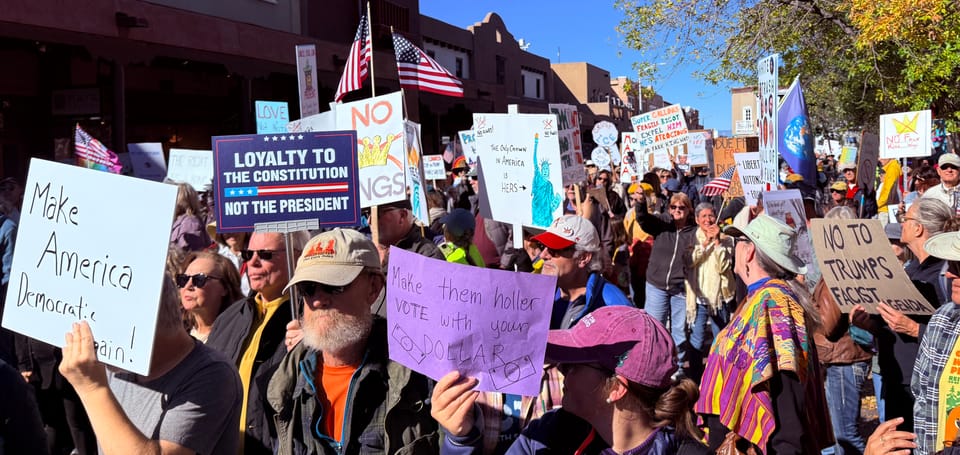
I keep seeing them when I close my eyes—the elders in sunhats and sensible shoes, flood of silver hair in the high desert light, filling the Plaza and the steps of the Roundhouse, trading sunscreen and lozenges and hard-won wisdom between chants. Santa Fe is a petite city, but when our neighbors gathered for the “No Kings” actions, the bodies carried decades of memory. If you were counting, at least half of the crowd wore Medicare cards in their wallets. And the energy wasn’t nostalgic—it was steady, focused, a kind of practiced courage that comes from surviving previous seasons of cruelty and not letting your heart go numb. (On June 14 and again in October 2025, tens of thousands rallied across New Mexico; in Santa Fe they marched from the Capitol to the Plaza with the same mix of song and steel you’d expect from seasoned organizers. And they gather again on March 28 for this Spring's No Kings rally)
Whether considering here in Santa Fe, or on the front lines of Minneapolis or countless other locales here in the US and abroad, I want to share some thoughts about those elders—not as saints, not as props—but as protagonists. Because if the twenty-first century has taught us anything so far, it’s that authoritarianism is a patient gardener: it cultivates fear, prunes solidarity, and waits for us to tire out. Elders flip the script. They remember that we’ve been here before. They know which arguments are recycled, which promises curdled in the heat of reality. And when they occupy the front row of a demonstration, riot police behave differently. A great-grandmother stepping forward changes the temperature of a confrontation. It’s not magic. It’s moral physics.
My mother was one of those activists. She and a few of her long time friends, never stopped organizing. At 84, he came back home from a community screening of a documentary on the Students for Democratic Society and suffered a massive stroke that would end her life in the months to come. She was in it until the end. And one of her vehicles for activism in Austin, Texas was the local chapter of the Gray Panthers.
A kitchen table in 1970
The kitchen table, not the marble conference room, is where this story properly begins. It’s 1970. A 65-year-old policy worker for the Presbyterian Church—sharp, funny, 5’2” of straight talk—has been forced out of the job she loves because the law says 65 is the end of usefulness. Her name is Maggie Kuhn. She does what elders have done since time immemorial when institutions fail them: she invites a few friends over. They gripe. They laugh. They plot. By the time the dishes are drying, they’ve named a fight—against ageism and for intergenerational social change—and they’ve chosen a stance: elders won’t retreat to the porch; they’ll step into the street.
Out of that table conversation grew the movement we remember as the Gray Panthers. Journalists liked the echo of other Panthers, but the substance was plain: end forced retirement, reform nursing homes, defend Social Security and Medicare, stand against war, stand with tenants and underpaid workers, and do it “young and old together.” Kuhn’s words still sting with relevance: “Leave safety behind. Put your body on the line. Stand before the people you fear and speak your mind—even if your voice shakes… Well-aimed slingshots can topple giants.”
I love Kuhn because she refused to silo age justice from the other fights of her era. She’d show up to talk nursing home reform and end up helping organize against the Vietnam War; she’d lecture about Medicare fraud and segue to women’s rights. She understood what our movements sometimes forget: the same hand that signs a law to throw you out at 65 is very often the hand that signs a war authorization, or a bill to turn migrants into quarry. Ageism is not merely a set of rude jokes; it’s a system that defines who counts—and who doesn’t—at each stage of life. Kuhn put elders back in the count. (I love this NY Times article from 2020 about her legacy)
Why elders, why now
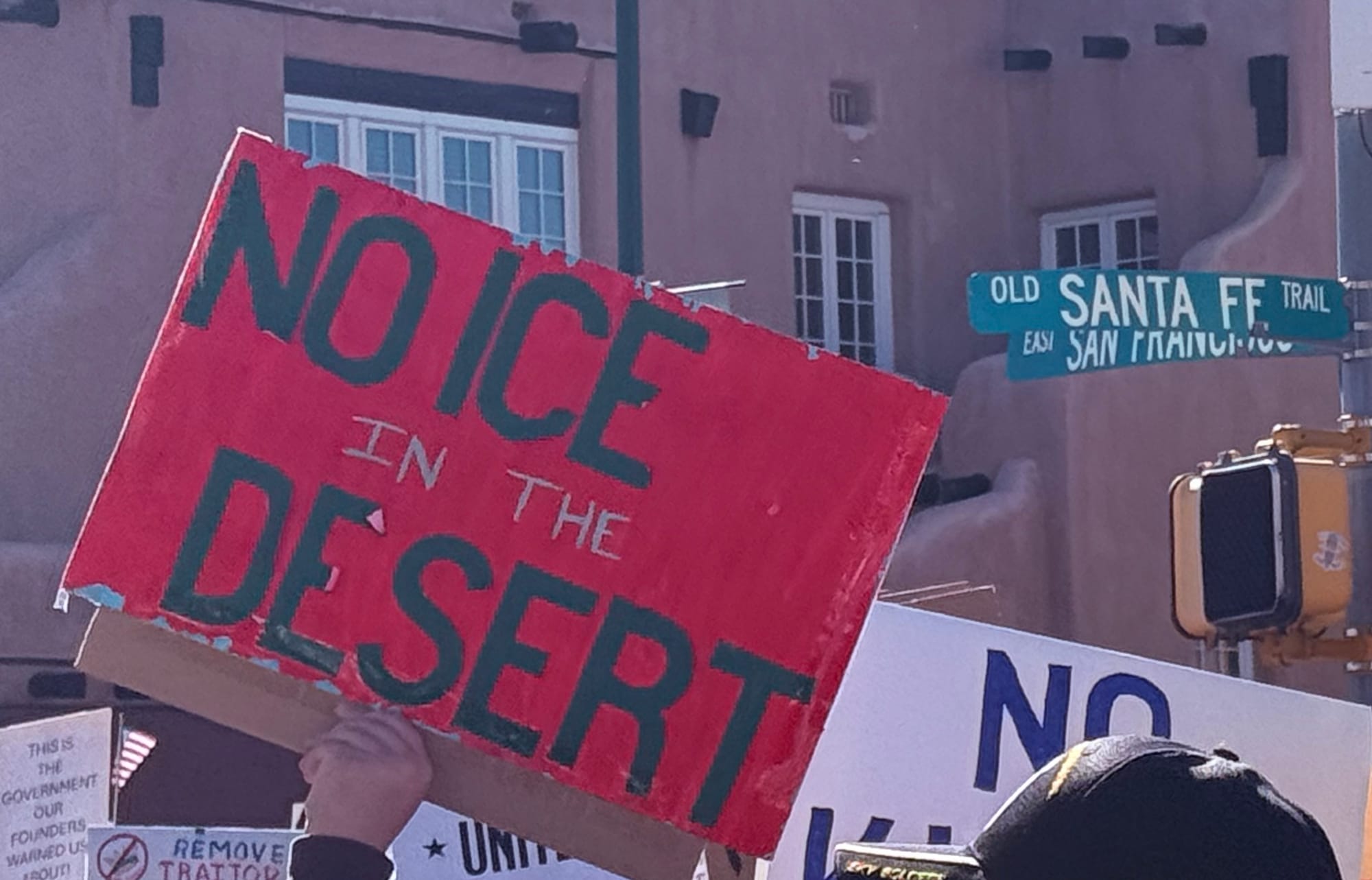
When I look out at a rally in Santa Fe, or tune into footage from current day Minneapolis, or latter day Warsaw or Buenos Aires, the elders are not a side note. Demographically, of course, the U.S. is older than it has ever been. But it’s more than headcount. Research keeps piling up that civic participation in later life—volunteering, organizing, showing up—is not a quaint pastime; it’s salutary. One large stream of studies finds that even a few hours a week of structured volunteering slows markers of biological aging and helps cognition. Washington University summarized it in 2024; UT Austin doubled down with cognitive findings in 2025; and the Washington Post stitched the evidence together in a clear 2026 feature. We tell people to go to the gym to age well; we should also tell them to go to the local sanctuary church meeting, find a ICE-watch training, or drop in on the online Indivisible chapter to help organize for March 28.
There’s theory under this practical advice. Laura Carstensen’s socioemotional selectivity theory says that as we age and perceive our time horizons narrowing, we trade novelty for meaning. Elders invest in emotionally significant goals and prune trivial obligations. In movement terms, that means fewer performative squabbles, more patience, more attention to relationships that actually move the needle. Elders can be the ballast in a coalition boat that young firebrand winds threaten to capsize.
Here’s another reason: elders carry institutional memory. They have long contact lists, long practice at process, and the ability to say, “We tried that in ’78; here’s what worked and what crashed.” When democratic norms wobble, that recollection is a civic vaccine. And because many are retired, elders can risk things other organizers cannot. Kuhn said it plain: “We who are old have nothing to lose! … We can initiate change without jeopardizing jobs or family. We can be the risk-takers.”
Voices, here and abroad
If you’re sketching an atlas of elder activism for today’s reader, you could do worse than begin with three names who each stand as a node in a larger network:
- Dolores Huerta, well into her nineties, still pressing for humane schools, fair immigration policy, and the everyday civics of registering and turning out voters. In 2025 she said out loud what many sensed—that “fascism” is not a historical ghost but a present danger—and she linked antidotes: organize, educate, show up. Her “Sí, se puede” was never a t-shirt; it was a calendar.
- Angela Davis, in her eighties, calls optimism a discipline rather than a mood—“we can’t do anything without it”—and insists on intergenerational learning: elders learning with, not lecturing at, young people. Optimism, for Davis, is not denial; it’s a daily decision to organize as if liberation is possible.
- Nina Bahinskaya, a retired geologist in Minsk, became a symbol in 2020 when she faced down police while waving the banned red-and-white flag. Belarus continued to persecute her into 2025, but her presence in the street had already done its alchemy: when elders step forward, regimes lose a layer of plausible menace. “I’m taking a walk,” she told police—a line that became a chant.
Add to these the chorus line of elder collectives who’ve built visibility into their method. The Raging Grannies—older women in bright hats and sharp lyrics—have been crowd-pleasers and conscience-prickers from British Columbia to small towns across the U.S. since 1987. They parody the stereotype of the harmless granny and lace it with subversion; they also teach an organizing lesson: humor is a durable solvent for fear.
And then there is the gold standard of persistence: the Mothers and the Grandmothers of Plaza de Mayo. These Argentine women turned grief for their disappeared children and stolen grandchildren into a human-rights movement that, nearly fifty years on, still identifies “nietos” through DNA and dogged search. In 2025, even as a new government indulged denialism, they announced the recovery of “Nieta 139,” proof that patient, elder-led work still punctures authoritarian myths. If you need a photograph of hope with wrinkles, look at their weekly marches around the square.
From Gray Panthers to gray power against authoritarianism
It would be easy—too easy—to say “we need the Gray Panthers back.” That was a particular movement in a particular time: post-1960s ferment, mandatory retirement laws, a media apparatus just learning to point cameras at elders who wouldn’t be cute. But the Panthers’ organizing perspective from the 1970s still reads like a guide for today: make age a site of power, not pity; build intergenerational alliances; treat housing, health care, and peace as one fabric; and cultivate a fearless elder stance that licenses younger people to step forward. The kitchen-table style remains essential. Durable movements are cooked, not catered.
And if we want the research to bless what we know from practice, we have it. The gerontology literature shows decades of work linking later-life civic participation to individual well-being and collective health. A 2019 scoping review review maps older people’s political engagement across policy domains; newer chapters track digital participation and late-life learning as political action. Even outside protest, older adults remain the most reliable voters and meeting-goers, the ones who keep community organizations solvent and municipal commissions honest. When the tide of authoritarianism rises, those habits become sandbags.
What elders offer—an asset map
Time and steadiness. Retirees can attend the long meeting, draft the long memo, hold the long memory. They can also take arrests, if they choose, without losing employment. Kuhn named this plainly—“we can be the risk-takers”—and it remains a tactical advantage.
Legitimacy with institutions. Legislators, judges, and administrators—many of them Boomers and Gen Xers now—have reflexes that still bend toward the elder who walks in with a tidy folder and a practiced courtesy. It’s not fair; it’s true. Elders can translate direct action into policy language without draining its moral charge.
Care infrastructure. Movements are not only speeches and marches; they are also childcare, crockpots, rides, and grief tending. Older adults have been cooking for revolutions since there were revolutions. If that sounds “soft,” ask any organizer what collapses first when the care loop breaks.
Health dividends. The personal benefits of engagement are not a selfish reason to show up; they are a sustainable reason. Volunteering and social participation are linked to slower biological aging and sharper minds. Imagine designing a “public option” for meaning in late life: city-sponsored pro-democracy volunteer corps, elder court-watch teams, intergenerational canvassing squads. Public health meets public will.
Narrative ballast. Elders are story scholars by necessity. They’ve had to make meaning out of loss; they’ve rehearsed forgiveness and the productive uses of anger. Movements need that ballast when outrage threatens to burn clean through the floorboards.
Story Work notes for organizers (and storytellers)
If you’re an elder stepping into this work—or a younger organizer hoping to harness elder power—build space for story. Story is not garnish; it’s governance for the heart. Creating Story Circles, joining workshops (like my upcoming Signpost Story Workshop), elder story slams (see the La Mesa Proposal I'm working on for here in Santa Fe in May), or just going for that post-protest coffee and listening to each other's stories, all of that provides the inspirational glue that keeps folks going, even when their tired bodies are suggesting rest over rebellion.
The elder future we need
Back to Santa Fe, to the plaza shade where you can hear the voices at once: a rancher who remembers the last time a sheriff came too close to a ballot box; a retired nurse who knows the hospital supply chain and how quickly it frays; a painter who doesn’t do Twitter but can paint a banner that a drone camera can’t ignore. This is the elder future we need: not simply older voters, but older neighbors turning their life’s harvest into shareable, usable wisdom.
I want to be careful here. We should not romanticize elders or instrumentalize them. Authoritarian movements are very good at recruiting elders with stories of lost greatness and stolen birthrights; we have to meet that myth with better memory. The progressive wager is not that elders are naturally virtuous; it’s that elders, when invited into courageous community, become more themselves—more precise, more generous, more stubborn about the right things. That’s the wager Kuhn made when she turned insult into invitation.
The world is not short of invitations right now. Our job is to write them with care. My own recent work with the Horizons Project as example (preparing for a No ICE in the Cup World Cup and USA@250 series of actions and protests), for those of us living and aging in a techno-authoritarian era, resistance requires us to withdraw from harmful systems and build convivial alternatives—tools and practices that amplify human connection rather than extract it. Elders are uniquely positioned to lead that build because they’ve lived before the algorithm, and they remember the worth of a room full of bodies and chairs and stories told out loud.
Closing with Maggie
So let’s close where we began, with Kuhn at the kitchen table. She’s scribbling notes on an index card, then looking up with a half-grin that says she’s about to get in trouble and absolutely delights in the prospect. “Do something outrageous every day,” she’ll tell a room full of elders who are trying to figure out if they’re allowed to want more from the world. Here’s my update for Santa Fe, for Buenos Aires, for Minsk, for every courthouse lawn where a folding table waits for a thermos and a sign-in sheet:
Be outrageous enough to be ordinary, together. Make your outrage an institution—meeting times, agendas, care rotations, songs. Ask the elders to lead the dignity work, the continuity work, the patient work of countering fear with fellowship. And when someone says you’re too old to matter, invite them to the table. There’s always room for one more chair, one more story, one more well-aimed slingshot.
Elderware Notes
Look for upcoming Elderware podcasts including interviews with Kelly Quinn (Feb. 20) on social media with older folks, Anne Basting (March 5)on the creative work of Timeslips in dementia care, Pia Kontos (March 20) on movement and dementia. I hope to have more frequent Ghost posts in the months to come, as well. Thank you again for subscribing!