ElderWare:
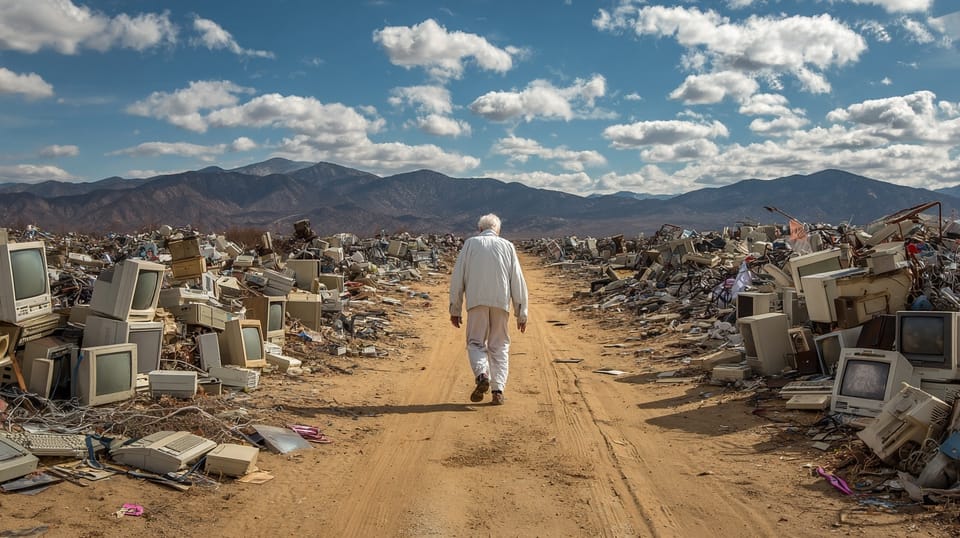
Story Work and Aging in the Mid-21st Century
I have always related to the stories I’m living. As a married person with no children working as an activist and artist, I connected with folks like me. As a parent of two children, the stories around me were of the tribe of parents. And as an aging person, I’ve grown fond of looking into the aging process and the stories it tells.
Here in my third age—my encore life—I want to see where the intersection of my interests in story and technology will take me. Specifically, I’m imagining three tracks: (1) exploring how I, as a sample elder in 2025, can be assisted in telling stories—let’s call this The Story of AI Joe; (2) surveying current apps, affordances, and technologies that are already changing story work by interviewing people building these tools or researching elder-centric technology; and (3) prognosticating about how emerging technologies might affect story in particular, and aging and memory work more generally.
Put another way, my approach is more of a detective tale: What is possible now, and what might be possible later? I’ll report on my own experimentation, learn from those researching or developing new technologies aimed at the over-60 sector, and sketch scenarios for where I think it’s going.
I hope you find this interesting and useful. As always, I’m happy to collaborate with anyone who wants to join the effort. You can reach me at joe@storyhost.net or joe@storycenter.org.
I should also note that in addition to publishing once a week here on Ghost, I'll be publishing a podcast on Spotify. Check that at here, Elderware: Story Work and Aging in the Mid-21st Century.
I enter the fray of Ghost, and podcast-based media with a simple request to my audience:
Listen with a smirk.
I created this project to engage my peers in a conversation about getting older. I imagined a relatively small but friendly audience that already knew me from my work in story and digital storytelling.
But if you’re not that person, I owe you a brief introduction. Everyone else can wait for next week’s post.
Joe’s Story
A reductive biography would say I was born the son of union and civil rights activists in Texas and the South, and that I took their inspiration into three overlapping careers. First, as a grassroots activist in tenant, union, and student/educational rights. Second, as a cultural worker, activist, and theater producer running a professional nonprofit theater in San Francisco. And third—by far the longest—as a co-founder of the digital storytelling movement and director of the San Francisco Bay Area–based international nonprofit known over the years as the San Francisco Digital Media Center, the Center for Digital Storytelling, and finally StoryCenter.
But what’s my story? Really.
Three short stories.
1980
I’d been working as a tenant organizer in Houston, running something called the Harris County Tenant’s Alliance at the ripe age of 23 in the spring of 1980. One of our allied groups was the SHAPE Center in Houston’s Third Ward. SHAPE did many things, but once in a while they had the audacity to put on a community theatrical production. That spring, the show was called “…And This Is South Africa.” Written by local playwright Thomas Meloncon and directed by the Zimbabwean artist Lindi Yeni.
I remember Lindi coming up to me at one of their Saturday food co-op events and asking,
“Joe, would you like to be in this play about South Africa?”
I looked around the room and, yes, I was the only white dude there.
“Lindi, I assume I’d have to play a South African policeman or soldier—a racist thug of some kind?”
Lindi smiled. “How did you guess?”
Typecast.
But of course I said yes.
Over the few months before the three-night run, I got bit by the theater bug. Theater had been one of my high-school interests, but in my early years of activism I wasn’t doing much of it. I decided I wanted to head in this direction.
As it happened, I was asked to return to California to do some student organizing, and I ended up at UC Berkeley. My major, “The Politics of Drama,” was a self-designed interdisciplinary humanities effort that examined politicized theater from the 1930s to that era. I wrote, I acted, I directed a bit, but mostly I studied the literature of theater and dug into how stories are constructed and how they can serve social change.
1983
I was a few months from graduating and knew I needed a job. My studies had included a survey of the Bay Area’s rich political and community-based theaters, including an interview with Susan Hoffman, who ran something called the People’s Theater Coalition.
I called her one April morning and asked if there might be an internship or some kind of work for me after my job at Cal ended on June 30.
“Funny you should call,” Susan said. “Our theater manager, Warren Johnston, just told me he needs to take medical leave on July 1. Maybe you could cover for him over the summer.”
“Sure—that’d be fantastic!”
Fast-forward a year. I’m sitting next to Susan in the meadow above Fort Mason. Warren never returned. In fact, he died of AIDS that spring. We were at his memorial. I’d remained the theater manager. Susan leaned over and whispered, “I thought I should let you know I’m pregnant, and I’m thinking of stepping back as executive director. Would you…?”
And so, I became a theater executive director.
1993
A decade in, I was still running a theater—now much larger than when I started—but I was also navigating a crisis. Of my many creative projects, one involved following my friend Dana Atchley—whose Next Exit one-man show inspired our model of digital storytelling—into the burgeoning world of digital media creation.
In those days, interactive CD-ROMs were the rage. Dana suggested we go to an IICS meeting at the little McBean Theater at the Exploratorium in San Francisco. It was January, the month before we would head to the American Film Institute for the now-legendary workshop that launched StoryCenter’s workshop model.
The room was packed—so packed I offered to host the next meeting at my theater. And at that next meeting, my 200-seat theater had 400 people stuffed into it. The presentation was Rick Smolan’s From Alice to Ocean, about Robyn Davidson’s trek with camels across the Australian outback to the Indian Ocean.
It was simply amazing, and I knew I was going to be part of this tsunami of creativity.
I usually tell the story of Monte Hallis’s Tanya video at the AFI workshop as the singular “spark” that led to my work in digital storytelling. But it was also the feeling—surfing emergent “movements”—that computer-based creativity was about to change the world. I wanted to follow that impulse. I did.
Were you to look at StoryCenter’s client list (probably a decade out of date), you’d get a sense of where the stories of 1993 took me. We traveled the world, inspiring thousands upon thousands to use our methods and principles of story work in the digital age.
In the last several years—first with my dear friend Linda Parris-Bailey in our Elder Circles online workshop, and later with my colleague Janet Ferguson in Walking Back the Long Road and Signpost Stories workshops—I’ve focused more specifically on people over 60 and the kinds of stories that tend to grow from lives with more mileage.
All of that work leads me, here in semi-retirement, to explore the stories that await us in the long third act of our lives.
—Joe
PS — You can join me in a workshop that starts this week: Walking Back the Long Road begins Friday and runs for six weeks. We have space, plus a 25% discount. Just visit Walking Back the Long Road and use code Story25 at checkout.