Finding Home in Each Other: Housing, Aging, and the Work of Belonging
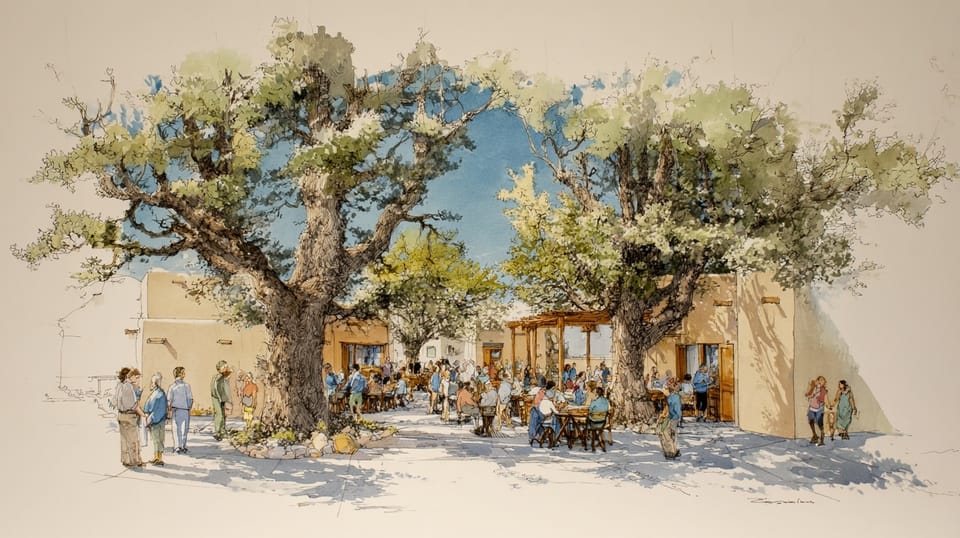
“We know from research that smoking shortens your life and that abuse of alcohol is also bad. But what most people die of is loneliness. It is a greater hazard, because it leads to people dying from cardiovascular disease, Alzheimer’s and other ailments. It also leads to people feeling overlooked and abandoned.”
From Why cohousing is so popular in Denmark
In my conversation with Australia’s Mark Silver, growing out of our exchange about intergenerational projects, we fell into a conversation about Judaism and community, or more specifically about kibbutzim, people connected to the kibbutz culture in Israel. I told Mark that my current living situation, as part of a well-established co-housing community, The Commons, reminded me of the kibbutz concept, at least what I knew about it. Not so much the “production” and mutual defense parts, but certainly the idea that children, parent aged, and elders should share spaces, making each a bit less isolated, a bit less lonely.
Mark said, “You are really living the story you are trying to tell about healthy aging, aren’t you?”
I laughed, but yeh, I’m trying.
Housing remains a very complicated issue for aging adults in most contemporary societies. People want to maintain a home until the last moment, but with children long gone, even adult children likely at some distance, older folks have to work at community until the day comes they find themselves in independent living, assisted living, or nursing homes of some kind or another.
I live in co-housing, which is another way of saying I live with the ordinary miracle of neighbors. We share gardens and meals, hammer out budgets, swap ladders and stories. It’s not utopia; it’s Tuesday. But in this season of life, I’ve come to believe the most radical technology for longevity and dignity is not digital. It’s social—our proximity, our rituals of showing up. And the stakes are high: the World Health Organization’s new Commission on Social Connection estimates loneliness contributes to roughly 871,000 deaths each year worldwide, with clear links to cardiovascular disease, diabetes, depression, and early mortality. World Health Organization+1
That public-health frame matters because older adulthood in the U.S. is unfolding inside a housing system that too often fractures connection. Over a third of older households are now cost-burdened—paying more than 30% of income on housing—with the total reaching a record 12.4 million in 2023. Burdens fall heaviest on renters and on older adults of color, reflecting long-standing inequities. Harvard Joint Center for Housing Studies+1 AARP finds that 75% of people 50+ want to remain in their homes and 73% in their communities as long as possible, but affordability and design barriers often stand in the way. AARP Meanwhile, only a tiny share of U.S. homes have the core accessibility features that make aging in place realistic. The Harvard Joint Center for Housing Studies (JCHS) reports that fewer than 1 in 25 homes meet basic criteria like no-step entries, single-floor living, and wider doorways—leaving millions struggling with entrances, bathrooms, and kitchens. Harvard Joint Center for Housing Studies+1
So where—and with whom—do we grow old?
The health case for connection
Let’s start with the why. The National Academies’ landmark report on social isolation and loneliness in older adults made it plain: social connection is a determinant of health, and isolation increases risks for premature death, dementia, heart disease, and stroke. Subsequent syntheses by researchers such as Julianne Holt-Lunstad reinforce that social connection functions as an independent predictor of mortality—one with population-level implications. National Academies Press+1 In practice, isolation also raises the odds of institutionalization: one 2023 cohort study associated social isolation with higher risk of nursing home use. JAMA Network
Flip the script and you see the power of everyday ties. Reviews of “aging in community” models—from NORC (Naturally Occurring Retirement Community) supportive-service programs to the “Village” movement—show consistent gains in perceived support, reduced isolation, and improved access to services. PMC+2PMC+2 A recent national review of Villages describes them as grassroots hubs that knit members to resources, neighbors, and purpose, strengthening the odds of aging well at home. PMC
Cohousing from the inside
Cohousing is one way to make connection structural rather than incidental. Born out of Denmark’s bofællesskab movement in the late 1960s and popularized in North America by Kathryn McCamant and Charles Durrett in 1988, cohousing couples private dwellings with robust common spaces and self-governance. Wikipedia+1 Research is still catching up to what residents long report anecdotally, but scoping reviews suggest cohousing can support well-being through daily, low-friction social contact and mutual aid. PMC
In my own community, the design nudges are simple but profound: a car-lite site plan that favors walking past porches; a common house where grief and joy both have a table; the gentle accountability of a sign-up sheet. We don’t eliminate loneliness, but we reduce the distance between needing help and actually getting it. That matters, because geographic proximity is destiny when it comes to care: national data show older adults receive far more help from adult children when they live within a few miles; beyond five miles, help drops sharply. PMC
Cohousing is not the only community-first model, and it isn’t accessible to everyone. But it illustrates a principle worth spreading: design for bumps-into-you moments; normalize reciprocity; embed governance in daily life; and make the walk from private to shared spaces feel easy and safe.
The landscape of choices (and non-choices)
Older adults navigate an array of options, and the “right” choice depends on health, finances, culture, and local supply.
- Aging in place at home is the preference of the majority. Yet with only a small share of homes accessible and the supply of paid home care stretched, many people struggle to convert preference into reality. AARP+1
- NORCs and Villages retrofit connection where people already live. NORC supportive-service programs and Village networks have documented reductions in isolation and improved access to supports—especially valuable for “solo agers” without nearby kin. PMC+2PMC+2
- Independent/assisted living and CCRCs provide purpose-built environments that can lower barriers to social engagement, though loneliness can persist in congregate settings and outcomes vary. Occupancy has rebounded post-pandemic (Q1 2025 senior-housing occupancy ~87.4%, IL 89.0%, AL 85.8%), signaling demand—while affordability remains a gatekeeper. PMC+1
Even within congregate settings, the presence of “third places,” robust activity programs, and strong resident councils appear to correlate with better social outcomes. But we should be honest: there’s no automatic cure for loneliness, whether one ages in a detached house or a dazzling campus. The pattern that keeps resurfacing in the literature is choice + proximity + purpose. BioMed Central
Family, mobility, and the fragile map of care
Extended family remains the most common scaffold for care. About 45% of Americans 65+ live within 10 miles of an adult child, and proximity strongly predicts the amount of help exchanged. But the story is uneven: many families are geographically dispersed, and overall U.S. mobility has fallen for decades, complicating “move back home” solutions. PMC+2PMC+2 Meanwhile, a growing share of older adults live alone (about 28%—16.2 million people), a figure that rises sharply with age. MSD Manuals
Advocates use “solo agers” to describe older adults who live alone without spouses/partners or children. Surveys suggest they make up roughly one in ten people 50+ and report higher worries about unwanted moves or lacking a decision-maker. The clinical literature (using the older term “elder orphans”) flags elevated risks when social supports are thin. AARP+2AARP+2
For immigrant families and communities of color, intergenerational ties are often strong, but unequal housing access and cost burdens strain those ties. In 2023, cost burdens for older households hit record highs; renters of color face the steepest rates. The equity lesson is clear: strengthening family care requires strengthening housing justice. Harvard Joint Center for Housing Studies+1
Planned community: old dreams, new tools
Today’s intentional communities sit in a long lineage of experiments in planned living. The kibbutz—a collective settlement combining Zionist and socialist ideals—organized daily life around mutual aid and common property; many later privatized, but the ethical imagination they sparked endures. Religious communities such as the Hutterites and Shakers structured common life around spiritual commitments, shared work, and—crucially—care for elders as a communal obligation. Meanwhile, civic planning movements like Ebenezer Howard’s Garden City reframed design as a tool to reconcile city and countryside and to seed neighborly life; American new towns such as Reston, Virginia adapted those ideas. Encyclopedia Virginia+5Encyclopedia Britannica+5GHI Washington+5
Cohousing borrows pieces from all of these: the kibbutz’s shared facilities without collective wages, the Shakers’ devotion to order (minus celibacy!), and Garden City’s insistence that form supports function. It also challenges the market’s default to isolate us by age, status, and staircase.
Where the market fails—and what justice demands
We can’t talk about housing for older adults without talking about power. When land, zoning, and financing reward scarcity and car-dependence, they discourage not just affordability but sociability. JCHS warns the U.S. is unprepared to provide accessible housing and services for the rapidly growing 80+ population. NIC data show rising senior-housing occupancy amid constrained construction, suggesting supply will remain tight. The math squeezes low- and middle-income elders first. Harvard Joint Center for Housing Studies+1
There are fixes within reach:
- Legalize “small” and “shared.” Reform zoning to allow accessory dwelling units, co-ops, co-ownership, and cohousing by-right. Pro-housing reforms can especially benefit older adults by expanding accessible, near-amenity options. Pew Charitable Trusts
- Fund connection as care. Expand NORC supportive-service programs and seed Village networks—evidence-backed ways to reduce isolation for those aging at home. PMC
- Retrofit at scale. Invest in home modifications (no-step entries, bathroom safety, lighting) and prioritize accessible design in all new builds. The biggest barriers are basic; addressing them prevents injuries and preserves autonomy. National Low Income Housing Coalition
- Target equity gaps. Close racial disparities in affordability and access, from rental supports to culturally competent assisted living. Census.gov+1
None of this replaces the interior work community requires: learning to argue honestly, to bring a casserole when words fail, to accept help without shame. But policy can set the stage for those human arts to flourish.
Choosing community on purpose
When I walk across our courtyard at dusk, the lights come on like a soft chorus. Someone is drilling a cabinet; someone is on the porch with a guitar; someone has left a bowl of plums with a note that says, “Please take.” We are not always easy. But we are, reliably, near.
That’s the heart of it. Whether you find it in a Village network, a NORC building, a co-housing cluster, an independent-living campus with a fearless resident council, or an old cul-de-sac that has decided to act like a block club, the task is the same: shorten the distance between our needs and one another. The research tells us why; the history shows us we’ve tried before; and the urgency of this demographic moment asks us to scale what works—equitably, accessibly, and with room for many kinds of belonging.
If aging is a long apprenticeship in interdependence, then housing is the workshop—part shelter, part stage—where we practice. My hope is that we keep designing places where, as our bodies ask more of us, our communities answer more quickly.
Sources
World Health Organization, Commission on Social Connection: global burden and risks of loneliness; 2025 global report. World Health Organization+1
National Academies of Sciences, Engineering, and Medicine. Social Isolation and Loneliness in Older Adults (2020) and highlights. National Academies Press+1
Holt-Lunstad, J. (2024). Social connection as a critical factor for mental and physical health. PMC
Harvard Joint Center for Housing Studies. Housing America’s Older Adults 2023; accessibility and preparedness. Harvard Joint Center for Housing Studies+1
AARP. 2024 Home & Community Preferences Survey: 75% of adults 50+ want to remain in their homes; 73% in their communities. AARP
National Investment Center (NIC) market data on occupancy (Q1 2025). National Investment Center
NORC/NORC-SSP evidence: reduced isolation and increased supports. PMC+1
Village model—national review of impacts and operations. PMC
Family proximity and caregiving intensity by distance. PMC
Older adults living alone (28% / 16.2M). MSD Manuals
Cohousing history and health/well-being evidence. Wikipedia+2Internet Archive+2
Equity and cost-burden trends among older households and renters of color. Harvard Joint Center for Housing Studies+1
Planned community lineages: kibbutz, Hutterites/Shakers, Garden City/Reston. Encyclopedia Virginia+5Encyclopedia Britannica+5GHI Washington+5