
Nickel-and-Dimed Time: How Class Writes Our Last Chapters
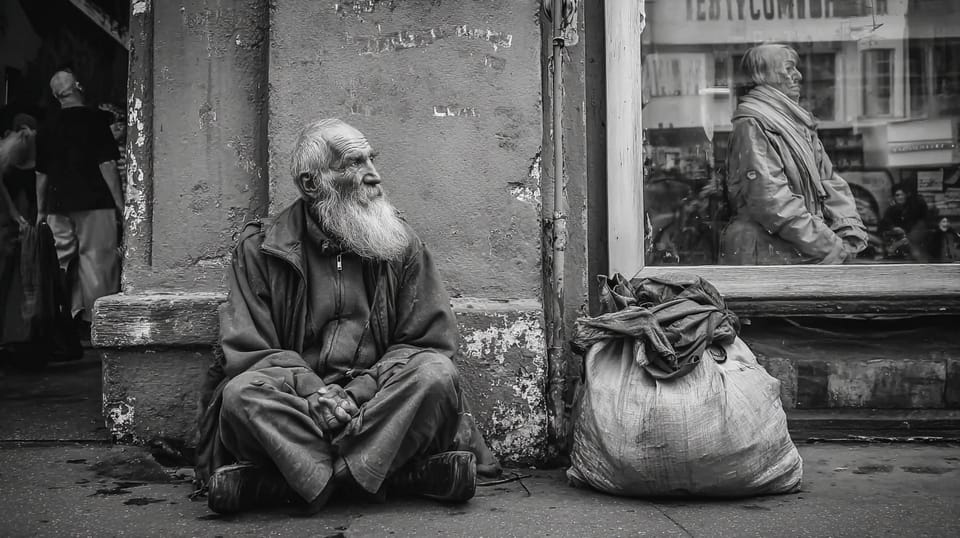
“Old age can be understood only in the context of social conditions and issues of the larger social order.” — Dr. Carroll L. Estes
I grew up in the home of a union organizer. Actually two organizers, although my mom was probably better described as a multi-issue organizer, race, gender, age (a proud Gray Panther for sure).
What I learned from them was dignity matters. Working people deserve it. And class systems undermine it. A good wage, for a day worked diligently, health care benefits, pensions, respectful working conditions. 150 years of labor struggle created much of that for people in the world, but to no one's surprise, every step forward is challenged, and as we are watching the United States, reversed, time and time again.
I spent some time this week reading a bit into the issues of class and getting older. My report is below.
Class Shows Up in Our Bodies
Here’s what I keep learning, watching my fellow elders around town in Santa Fe: class writes itself into our bodies. The unhoused elder on the corner and the jet setting patricians strolling through the plaza here in Santa Fe, provide a daily contrast.
But I can also imagine what it is like for all wage earning working folks. It settles into the knees of the home-health aide who lifted strangers for decades, and it leaks into the breath of the warehouse worker who carried America on his spine. By the time we are old, class is less an abstract noun than a weather system moving through our bones. And as Carroll Estes insists above, we must name the weather, not blame the umbrella.
I am a fan of many writers in a America, but Barbara Ehrenreich's Nickel and Dimed book, was one of the most influential. She taught me to keep my ear on the breakroom radio of America, where “hard work” is the sermon and kitchen-burns are the sacrament. She wrote: “You could work hard—harder even than you ever thought possible—and still find yourself sinking…into poverty and debt.” That’s not just a line; it’s the working-class liturgy. And when you carry that precarity into your sixties and seventies, the story doesn’t resolve; it compounds. The richest and the poorest live in different time zones of the body. Between the top and bottom of the income ladder, life expectancy differs by about a decade for women and nearly fifteen years for men. That gap is not a metaphor; it is literal years subtracted or added—policy rendered as pulse.
Blueprints We Still Live In
In my wee bit of research, I ran into Jill Quadagno, who reminded me how we built the scaffolding that still shapes our aging. In a talk reflecting The Color of Welfare, she put it plainly: “The New Deal created Social Security, but three-fifths of African Americans were excluded…because agricultural and domestic workers were not included.” That exclusion planted a classed and racialized seed we harvest still—thinner pensions, fractured savings, later-life insecurity that is not accidental but engineered. When we discuss “healthy aging,” we’re too often asked to ignore the blueprint. Quadagno asks us to read it, line by line.
Then I bumped into Angela O’Rand. Angela gives us the life-course lens to see how small cracks become canyons. Cumulative (dis)advantage sounds academic until you put faces to it: the hotel housekeeper whose wrist never healed, the machinist laid off at 58, the grandmother who stepped out of the labor market for caregiving in her forties and never fully stepped back in. As O’Rand observed, explaining “increasing heterogeneity and inequality within aging cohorts” is a core task of our field; it’s what keeps us honest about the layered ways class stratifies old age. Once you hear that music, you can’t unhear it; the backbeat of inequality is steady.
Even once you’ve “made it” to Medicare, class doesn’t take a nap. Traditional Medicare still largely excludes routine dental, vision, and hearing care—the very senses that keep us eating, socializing, staying upright, and connected. Among beneficiaries who used these services, average out-of-pocket spending can land near a thousand dollars for hearing or dental in a year. For a retiree on fixed income, that’s not a line item; it’s a barrier. And if you need long-term services and supports, the meter spins: the national median for a nursing home runs into six figures a year. These are not “choices” in any meaningful moral sense; they are bills that break people.
Layer on the poverty math. Social Security remains the country’s most potent anti-poverty program, lifting tens of millions above the line, including millions of elders. And yet economic insecurity—measured at twice the poverty threshold—remains widespread among older adults. Class doesn’t evaporate at 65; it hardens.
When Gender Braids with Class
I next found myself reading Toni Calasanti on the way class and gender braid together. “I argue for a framework that theorizes the intersections of relations of gender inequality with those of age,” she writes. In practice, that means two older people with the same income may meet very different futures because the price of a long life is paid differently across gender lines—who did the unpaid care, who missed the raises, who trusted a husband’s pension that never materialized. Older women—especially Black, Latina, and Indigenous women—arrive at the threshold of old age more likely to juggle part-time work, childcare for grandkids, and their own health-care gaps. In the story circles I some times get to lead with older adults across gender, race and class lines, you can feel the texture of that juggling in the breath between sentences.
Madonna Harrington Meyer handed us a portrait of contemporary grandmothering that puts policy in a rocking chair and asks it to explain itself. “There’s a huge shift in what’s expected or requested from grandparents,” she notes—grandmothers ferrying children to appointments, tucking them in, covering the shifts no institution will fund. This is not a Hallmark add-on to retirement; it’s the off-the-books infrastructure that lets the formal economy pretend it works. When we refuse to fund care, we convert older women’s time and bodies into the subsidy. Meyer’s research makes that subsidy visible.
If you want the macro number behind that intimacy, here it is: family caregivers provide tens of billions of unpaid hours annually—valued in the hundreds of billions of dollars. That is love with a ledger, and it is overwhelmingly borne by families with the fewest dollars to spare. Caregiving is an equity issue—class determines how much leave you can take, what respite you can afford, whether your elder gets a home-health aide or a hope and a prayer.
Deborah Carr’s work on widowhood keeps us honest about the aftershocks. “Widowhood has important consequences for the…economic and psychological well-being of older adults,” she and colleagues write. Grief, in America, comes with price tags: a tablet bill for the cardiologist portal, a new rent if you can no longer afford the home, a car repair that decides whether you see friends or isolate. Class shapes each of those decisions; for many older adults, especially women, bereavement is also a financial downdraft.
Designing Different: Policy Moves that Shift the Weather
So what do we do, as storytellers and citizen-planners? First, we refuse to individualize what is structural. Estes gave us a vocabulary for that refusal; Ehrenreich gave us its sound. We reject the fitness-tracker fable that “aging well” is achieved by optimizing the self while leaving the system untouched. We live in a house built by law and budget, zoning and payroll, and it leaks on cue over the same people every time. Good narrative practice names the roof and asks who pays the roofer.
Second, we move resources to where the leaks are worst. Expand Medicare to include robust dental, vision, and hearing coverage; stabilize home- and community-based services so families aren’t forced into institutions simply because that’s the only benefit Medicaid reliably funds. Build social insurance for long-term care—shared risk, universal participation—so that your chance of developing dementia isn’t also a test of whether your family is middle class. Create paid family leave that does not expire at the nursery door but recognizes eldercare as the other half of the life-cycle.
Third, we shore up income floors. The evidence is not ambiguous: income buys time. Elders in low-income neighborhoods do not need more “resilience workshops”; they need enough money to cover medication, fresh food, a working furnace, and a bus that shows up. Social Security must not be chipped away; in fact, targeted enhancements for the very old and for low lifetime earners would directly reduce class-driven gaps in late-life hardship. Because women are more likely to live longer and poorer, gender-aware reforms—credit for caregiving years, improved survivor benefits—are equity by design.
Fourth, we fund care workers like we mean it. The elder-care workforce—overwhelmingly women, disproportionately immigrants and women of color—has spent decades subsidizing the rest of us with low wages. A fair wage, benefits, training ladders, and protections aren’t just moral; they are system design. When we stabilize care jobs, we stabilize elder lives and the families orbiting them.
Fifth, we center story to sustain the urgency. I’ve watched how a room changes when a retired farmworker describes choosing between a tooth and a transmission, or a widow reads a paragraph about the first grocery run alone. The metrics matter, but the story puts the numbers back in a human mouth. “Personal responsibility,” the old shaming refrain, dissolves under a well-told life history; you can hear policy instead of moralism, design instead of blame.
And because narrative without a destination can feel like weather without a forecast, here’s the horizon I’m aiming for: I imagine the last chapter of life as a porch at sunset—room enough for friends and grandkids and the neighbor who stops by, a porch steady under everyone, no matter the paycheck that got them there. If class has been etching itself into our bones all along, then policy must be our physiotherapy, narrative our daily practice, solidarity our medicine. We have the scholarship. We have the numbers. Most importantly, we have the stories. Let’s write back to class—together—until that porch is built, and every elder can sit without worry and watch the light do its gentle work.
P.S. If you want a pocket guide to carry into the next meeting, here’s mine:
- Estes: aging is political economy—ask who designs the weather. PMC
- Quadagno: our safety net was stitched with exclusions—repair the seams. emory.edu
- O’Rand: inequality accumulates—interrupt it early and often. PubMed
- Calasanti: gender and age co-produce power—design with that in mind. PubMed
- Harrington Meyer: grandmothers hold up the sky—fund the pillars. Maxwell School
- Carr: grief has economic gravity—build cushions where people fall. Boston University
- Ehrenreich: the low-wage engine runs on human sacrifice—stop pretending it’s a virtue. Goodreads