Senior Centers and the Art of Aging Together
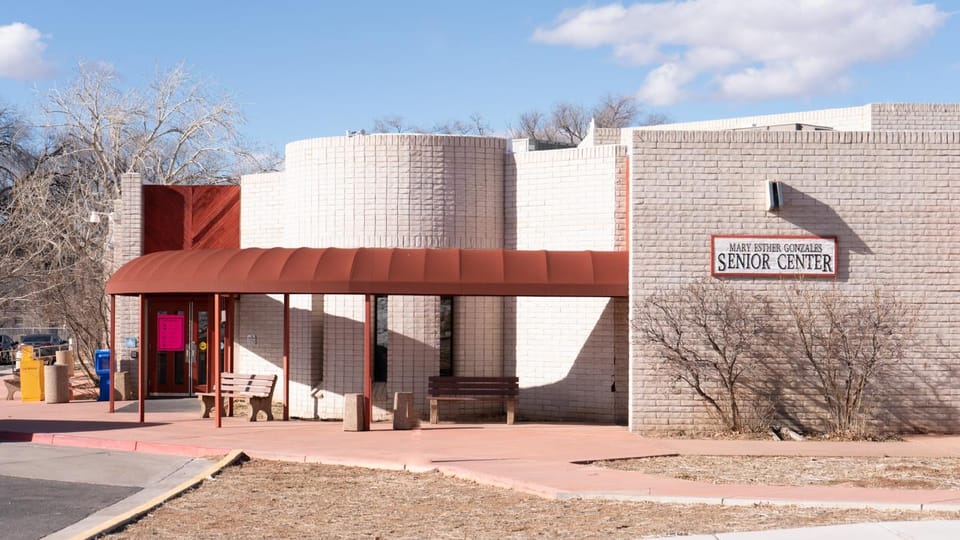
Down the river from me is the Mary Esther Gonzales Senior Center on Alto Street (aka MEG). I’ve walked and rode by it a hundred times. But never journeyed in.
But walking my dog today adjacent to the center got me thinking about Senior Centers. StoryCenter was once next to one of the Berkeley Senior Centers, and my daughter’s pre-school was next to the one in Albany, CA, and I found these center’s an important part of the communities I lived. I'd visit, I did a few programs on an off. I’ve always thought they were for someone else. Now I’m that person. A senior wanting to know more about the services they offer, but more generally about why they even exist.
According to Manuel Sanchez, Santa Fe’s Senior Services Director, the MEG was constructed in 1975. 50th anniversary year, then. (Citizen Portal) Why not earlier? Why not later? So I fired up the search and started reading up on the history, and the ways these center’s function in the tapestry of civic life. Even a little bit of research had me conclude that senior centers are one of the quiet masterpieces of the American experiment. They’re part of the “infrastructures of aging”: not roads and bridges, but the rooms where we learn to carry each other’s stories.
How we got here
Before the term “senior center” had its own line item, the impulse lived in church basements, settlement houses, and neighborhood clubs where older adults—especially immigrants and the working poor—found fellowship, English lessons, and a hot meal. The settlement movement that Jane Addams helped anchor at Hull House braided together mutual aid and civic education; it was practical utopianism, a public home for people who were otherwise expected to endure in private. (ARDA)
The federal scaffolding arrived with the Older Americans Act of 1965, a Great Society promise that aging should be met with services, not stigma. The OAA authorized supportive services, nutrition, and—crucially—multipurpose senior centers. Over the years, amendments pushed centers to become “focal points,” where an older adult could connect to the whole web: meals, transportation, benefits counseling, health promotion, legal aid. (ACL Administration for Community Living) Title III funding still helps states and local agencies operate and even renovate centers, though the work is usually stitched together with municipal budgets, county millages, philanthropy, and a thousand volunteer hours. (National Council on Aging)
Today, there are on the order of 11,000 senior centers in the U.S., serving more than a million older adults daily. They remain the most visible neighborhood presence of our aging network—where you can get your blood pressure checked, a hot lunch, a Zumba class, and advice on Medicare, all before 2 p.m. (National Council on Aging)
Three waves of evolution
Wave 1: Lunch, bingo, and lifelines. The stereotyped image—congregate lunch, cards, case workers in the back office—had a lot of truth to it. Early research from the 1970s–1990s showed users tended to have lower income and education; they came for company and “something to do,” and they stayed when the activities felt relevant. It was social insurance in a social room.
Wave 2: Wellness and aging-in-place. As states and cities recognized that staying at home is both what people want and what budgets demand, centers reinvented themselves as health hubs: fall-prevention classes, chronic-disease self-management, balance and strength training; computer labs and tech tutors; benefits counseling for SNAP and Medicare. The National Council on Aging’s scan of “today’s senior centers” reads like a prescription for dignity: evidence-based programs, digital access, lifelong learning, and purpose. (assets.ncoa.org) If you want a concrete picture, look to Midland County, Michigan, where a small 1960 activity center grew into five centers plus adult day services, running transportation, Meals on Wheels, classes, and caregiver support across the county. (Midland Daily News)
Wave 3: Hybrid, intergenerational, and beyond the building. COVID pushed centers to pivot—phones and Zoom rooms substituting for cafeterias and crafts. Some innovations stuck, even as we wrestle with the digital divide. Studies of community organizations serving older adults during the pandemic map the terrain frankly: virtual delivery increases reach for some, but cost, devices, and confidence are real barriers. (PMC) The future looks less like a single building and more like a network: partnerships with libraries and colleges, housing providers and child care, NORC programs woven into apartment towers and neighborhoods so that “the center” meets people where they live. (Wikipedia)
The intergenerational turn
Once upon a time I gave a keynote at the Generations United national conference in DC, and learned about the entire world of intergenerational programs, projects and facilities. They support an entire movement, that moves beyond one-off visits; to ongoing, mutually beneficial relationships that build social capital for the whole neighborhood.
The research base on intergenerational programs has grown from feel-good anecdotes to systematic reviews showing improvements in life satisfaction and reductions in loneliness for older adults, along with empathy and social skills gains for youth.(PMC) (covered a bit in my podcasts with Peter Whitehouse and Mark Silver).
And because my work lives at the intersection of story and aging, I’ve witnessed iintergenerational magic time and again, from my years as the program director for the Digital Clubhouse Network, to dozens of workshops that bridged generations, to the numerous times I had a grandparent and child join one of our public workshops as a collaborative experience. You could measure the digital literacy, sure—but you could also measure the dignity. The evidence base is catching up with what our hearts already know: when generations meet on purpose, loneliness softens and purpose returns.
Some places have taken an architectural leap—shared-site models where adult day services or senior centers live under one roof with child care or schools. The results are tender and practical: elders rocking babies in Los Angeles, toddlers wandering through songs with grandfriends in Seattle. (And yes, it helps elders with dementia find purpose and rhythm again.) (PMC)
If you zoom out internationally, you see cousins to our senior center model. In Japan, community salons—kayoi-no-ba—are low-cost neighborhood gatherings that mix health promotion and hobby groups; participation is linked with lower disability risk and richer social ties. (PMC) Another Japanese innovation, kodomo shokudō (children’s cafeterias), began as grassroots responses to child hunger and have become intergenerational commons where older adults volunteer, eat, and mentor—a different doorway to the same house of belonging. (Musubie) The throughline is clear: age-integrated public spaces are health infrastructure.
Equity: who walks through the door, who doesn’t?
I grew up in rooms where people argued about justice over plates of spaghetti or tuna casserole. Senior centers are those rooms, too. The hardest question is whether they are reproducing inequities or mitigating them. The honest answer is: both, depending on the zip code and the choices we make.
Social determinants of health—transportation, housing, language access, digital inclusion—shape who benefits. National guidance on healthy aging hammers the point home: nearly 1 in 10 older adults lives in poverty; rural access is fragile; transitions in insurance and care can be baffling; literacy barriers are real. (Health.gov) Qualitative studies show older adults hitting invisible tripwires—fragmented information, bureaucratic mazes, stigma about “needing help.” (BioMed Central) And transportation is the quiet deal-breaker: if the bus doesn’t come, neither will the people. (National Council on Aging)
The good news is that the field knows this and is moving. NCOA has collected dozens of practices from centers that are reaching isolated elders—community vans, multilingual outreach workers, culturally specific programming, trusted messengers. Equity isn’t a sentiment; it’s a calendar, a staff roster, and a fuel budget. (National Council on Aging)
In Santa Fe, you can see the equity work in the details: bilingual flyers, SHIP/SMP counselors who will meet by phone or at home if the trip downtown is a barrier, and programs for grandparents raising grandchildren. When the gas line hiccupped last winter, the MEG crew adapted quickly; when the building got its upgrade, the first question they asked was, “Does it make it easier to gather?” That’s an equity test as good as any rubric.
Where next?
If senior centers are the infrastructures of aging, then our job is to keep rebuilding them around the lives that are actually being lived. The policy frame is sturdy—the Older Americans Act still gives us permission and resources to run, renovate, and reimagine. (National Council on Aging) The practice is where we show our values: hire staff who speak the languages of the neighborhood; program for queer elders, Indigenous elders, undocumented elders, and elders with disabilities and chronic pain; braid in child care and teen councils; wire every room for hybrid participation; fund the vans; pay the musicians. Let’s design first for those who’ve been last in line.
In the seven steps approach at StoryCenter, we talk about owning your insights—how a story can move from problem to meaning to change. Seems to me, senior centers are trying to do that in real time.
My local senior center has been at it for fifty years and I’m confident, will serve for fifty more. When a community decides that aging is a shared project, then all stories can be lifted.
Notes & sources — Older Americans Act texts and overviews (authorization of multipurpose senior centers; “focal point” role): ACL and CRS. (ACL Administration for Community Living) — Funding and operations for centers (Title III-B; acquisition/renovation authority; implementation via AAAs): NCOA brief; Florida DOEA; eCFR/Title III regs. (National Council on Aging) — Scale and visibility of centers (≈11,000 centers; >1M served daily): NCOA. (National Council on Aging) — Intergenerational benefits (reviews and fact sheets): Generations United; systematic reviews in Frontiers in Public Health and on PMC. (Generations United) — COVID pivots to virtual and ongoing barriers: BMC Geriatrics review. (PMC) — International cousins (Japan salons, kayoi-no-ba; Kodomo Shokudō): peer-reviewed and conference sources; corporate summary. (PMC) — Equity and access (SDOH; transportation; “hard-to-reach”): ODPHP; NCOA; transportation/health linkage. (Health.gov) — Santa Fe specifics (MEG expansion; Director’s statements; collaboration with County): City “Senior Scene” magazine; local reporting.