The Age Pass: On Malaise, Mercy, and Making Peace with Help
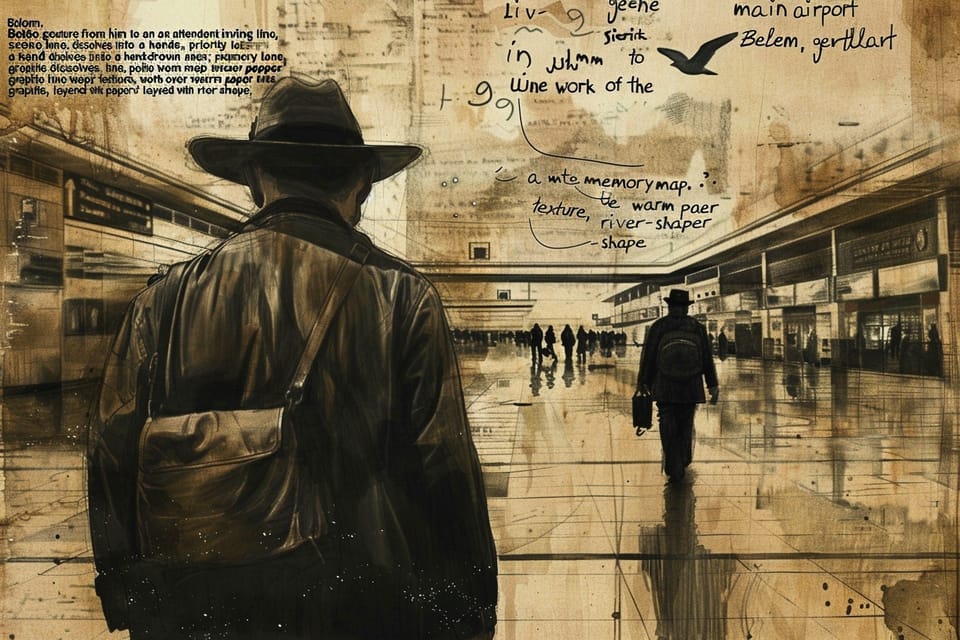
There was this moment, when Brooke and I were standing in the boarding line at the Belém airport on Thursday, when the nice guy organizing the queue took a look at me and, in Portuguese, suggested what I understood to be, “Oh, you can bypass the line, given your age.”
A first for me. I wasn’t sure how to read it. Did I suddenly look in need? Was there an indicator in my face—or, as Brooke suggested, my slumping, hunched-over posture? In a second I was plopped into the sense that I am that guy now, the old one that needs help.
This two-week trip—like I wrote last week about travel and mobility—has been a challenge on the physical, but I noticed it on the mental level too. The two are braided. As things get shaky, you do a vitality check, and that sense that the energy battery re-charges so much slower these days—well, that’s a buzz kill.
I’m not the strong or the silent type, not really. I’m a self-examined talker. And still there’s this shadow of unexpressed vulnerability—a quiet grayness that isn’t quite depression, but it’s not not depression either. A heaviness in the mornings, a sense of being slightly out of phase with my own life. If that rings for you—or for the men you love in their late 60s and early 70s—let’s talk about this weather and what helps.
The gray zone: not crisis, not nothing
What many men feel here is malaise—a low, steady hum of “meh”—with a subset sliding into what clinicians call late-life or subsyndromal depression. In older adults, mood disturbance often leans less “sadness” and more anhedonia—that dimmer switch on pleasure—plus sleep shifts and cognitive “slowness.” Current syntheses keep flagging anhedonia as central to severity and slower recovery in late life; if joy feels out of reach, that’s data, not a defect. (Verywell Mind)
This mood also rides a two-way street with the body: medical issues make malaise worse; malaise makes medical issues harder to manage. That’s why a simple trip—time zones, odd meals, blue-white light at 2 a.m.—can tip the balance. The circadian system runs tighter with age; early-day bright light and a steady wake time help re-anchor energy and mood after travel or winter. (Verywell Mind)
So, if you’ve felt “washed out” for weeks, less delighted by what used to sparkle, and you’re waking too early or sleeping too much—no, it’s not just you. It’s a known pattern. And it’s workable.
The Latin American future we’re already living
I write from my last days in Latin America, and so I spent a moment looking into these issues from that lens. And as always, I was eager to borrow from sources outside the US/European context for ways for us to expand my understanding of these issues.
Latin America is aging fast—and unevenly. ECLAC/CEPAL tracks the shift clearly: people 60+ in the region will move from roughly 85 million (2020) toward ~200 million by 2050, confronting care systems that aren’t yet scaled for the demographic curve. That’s the “design brief” for malaise at population scale. (igualdad.cepal.org)
Brazil offers an ecosystem view:
- Museu da Pessoa and Karen Worcman’s Tecnologia Social da Memória give communities a method to treat everyday lives as public heritage. It’s story-as-infrastructure, not just art—precisely the move that “signifies” older lives as civic assets. (The method booklet is free, in Portuguese.) (museudapessoa.org)
- LAB60+ reframes longevity as a cultural movement—festival, labs, a web of partners—to practice a new narrative of aging in public. (lab60.org)
- Instituto de Longevidade MAG publishes the IDL (Longevity Urban Development Index) gauging how Brazilian cities support older adults—great when you argue for city-level fixes that make malaise less likely (walkability, safety, work options). (Instituto de Longevidade MAG)
- Nova Longevidade Lab mapped 403 initiatives in 2024 that are “rethinking aging” across health, intergenerational connection, purpose, and anti-ageism—evidence that pilots are everywhere if you look. (Nova Longevidade)
Brazilian research adds texture: a SciELO qualitative study with dependent older adults describes the familiar cluster—slowed enthusiasm, anxiety, “feeling like a burden,” sleep disturbance, bodily complaints. That’s your “low-battery” portrait with local voice. (SciELO)
And ELSI-Brasil (the national longitudinal study) remains the best doorway for data on determinants and trends. (elsi.cpqrr.fiocruz.br)
Argentina’s Fundación Navarro Viola (FNV) is a Spanish-language partner to point to: their Personas Mayores program suite (from “Vivir con Bienestar” to intergenerational projects and a meaty “Información y conocimiento” portal) models how a foundation can build culture, research, and practical resources in one place. (Fundación Navarro Viola)
And a current example: Mnemos launched Raíces de la Memoria in Buenos Aires with FNV in 2025, explicitly framing older people’s stories as shared civic memory. (Agencia Mnemos)
It strikes me that Elderware is definitely about these type of integrations, where memory, story, and creative application of a mix of technological affordances, give us a new cartography of how this part of our lives can play out, rich, interconnected, pleasant enough to be borne with dignity.
Ancient futurism: making tomorrow with long memory
In the coming months I’ll be once again engaged with the 100 Years Project, my third collaboration with higher education folks looking toward the next 50 years of change, based on the enormous change of the last 50 years.
When I started the project, I gave my own take on the challenges of the next 50 years, in this overview video. Like a number of us cultural activists, including my dear friends at the Museum of the Person, we are leaning toward our indigenous teachers, that their deeply held sense of what environmental respect and sanctity has to show us out of this way out of the mess. Both at the grand scale of things like the COP30 event I was adjacent too, but also on this deeply personal level, I am considering here.
The best part of getting older is finally admitting the future will be built with old tools. Many of us are calling this ancient futurism—designing modern supports with Indigenous and Global South wisdom about balance, belonging, and land. Here’s just a few examples that I feel are relevant here.
- Te Whare Tapa Whā (Aotearoa New Zealand). Sir Mason Durie’s model pictures wellbeing as a meeting house: spiritual (wairua), mental/emotional (hinengaro), physical (tinana), and family/social (whānau), grounded on whenua/land. It’s not a metaphor only; clinics and communities use it as a check-in: “Which wall is weak today?” That lands for men who prefer practicality over pathologizing. Ministry of Health NZ+2mentalhealth.org.nz+2
- Clinically, the Meihana Model extends this for assessment and care pathways—good reading for any practice wanting to operationalize cultural safety. The New Zealand Medical Journal+1
- Yarning / Talking Circles (Australia, Turtle Island). These are slow, relational methods for truth that prioritize consent, reciprocity, and pace—great antidotes to the rushed clinic visit. Health research documents their validity when Elder-led and local. Consider a monthly “Men’s Yarning + Making” night at the library workshop. BioMed Central+2SAGE Journals+2
- Ubuntu (Southern Africa). “I am because we are” resets the script: asking for help maintains the web, it doesn’t burden it. Ubuntu-informed community mental health reframes elder care as mutual care, not individual failure. PMC+2socialserviceworkforce.org+2
- Sumak Kawsay / Buen Vivir (Andes). Living well as balance with people and planet—not accumulation—keeps elders at the center as memory holders. It’s in philosophy and in policy (see Ecuador’s 2008 Constitution). scienceopen.com+1
None of these traditions demand that you become someone else. They remind you that your “battery” is not just chemical; it’s communal, seasonal, and storied.
Designing the week around energy, not ego
Let me translate this into a week I want to practice coming out my current journey borrowing from from some Maori concepts in the Mason Durie model. Maybe you could borrow as well.
- Monday (Tinana / Body): Ten minutes of morning light (sun or a 10,000-lux box) soon after waking stabilizes circadian timing and nudges mood; add 15–25 minutes of resistance work (two compound moves, scaled). It’s not metaphor; these are first-line, low-side-effect interventions for late-life mood. Record a 60-second note afterward: What changed? (Verywell Mind & PMC)
- Tuesday (Hinengaro / Mind): Schedule one small mastery task per day—sharpen tools, label old photos, prep beans from scratch, teach a neighbor how to fix a hinge. These “click complete” acts are anhedonia antidotes. BMJ
- Wednesday (Whānau / Social): Reciprocity beats malaise. Offer a micro-favor; accept one. In Buenos Aires or Belém that can be as simple as “Can you walk with me to set a second stair rail?”—and yes, make a note of it. (Community programs like FNV’s “Vivir con Bienestar” or LAB60+ events are perfect places to practice this safely.) (Fundación Navarro Viola)
- Thursday (Wairua / Spirit): A short gratitude + grief note—two sentences each. (Malaise often masks unmarked grief about capacities changing.)
- Friday (Story): A Seven Stages prompt: “What changed in me when I let the nice man wave me to the front of the line?” Record 90 seconds; title it.
- Weekend (Land): Ritual with place: take that longer walk with your partner/dog/own mind, treat yourself to a nature spa in the woods or desert, float in a body of water (like the amazing Atlantic Coast here in Brazil or your bath tub!). Humans are seasonal creatures; your nervous system notices.
I’ll try to practice this in the coming years, not as prescription, but as a rhythmic mind/muscle to engage as I can.
The meaning move
Here’s what I think is really happening in that airport line. A stranger offered a mirror; I saw an older version of myself I hadn’t fully met. The first wave was offense (“Do I look that old?”). The second wave was grief (“Something's happening here and I didn't see it coming!”). The third wave—the one that saves the day—was meaning: I am still learning how to accept help without surrendering agency. That’s a teachable skill.
Story makes that move repeatable. Finding healthy practices in exercise/yoga/meditation is what we all know is fundamental; but adding story and reflective inquiry can be just the extra something that can solidify the why or all this preventative effort. In these years of living vulnerably, that boon is often modest and holy: “I asked for a second handrail and felt the house love me back.”
If your battery feels low and the world is gently offering you the “age pass,” try this: take the pass, tell a tiny story about how it felt, lift something just heavy enough, step into the morning light, and trade a small help with someone on your block. Repeat. That’s not giving in; that’s training for the new terrain.
And when the gray rolls in again—as it will—remember the long memory: the house has four walls; the circle waits for your yarn; the village thrives when you ask and when you give. That’s ancient futurism, right there: older ways, newly lived.
Sources
- Tecnologia Social da Memória (Museu da Pessoa, PT, PDF). (museudapessoa.org)
- LAB60+ (festival/movement). (lab60.org)
- Instituto de Longevidade MAG — IDL 2023 (age-friendly cities index). (Instituto de Longevidade MAG)
- Nova Longevidade Lab — Mapeamento 2024 (403 iniciativas). (Nova Longevidade)
- ELSI-Brasil (national longitudinal aging study). (elsi.cpqrr.fiocruz.br)
- SciELO qualitative study on mental health among dependent older Brazilians (PT). (SciELO)
- CEPAL/ECLAC — Envejecimiento en ALC (regional report + figures). (CEPAL)
- Fundación Navarro Viola — Personas Mayores + Información y conocimiento (ES). (Fundación Navarro Viola)
- Raíces de la Memoria (Mnemos + FNV pilot, 2025, ES). (Agencia Mnemos)