
The Space Between Care and Home
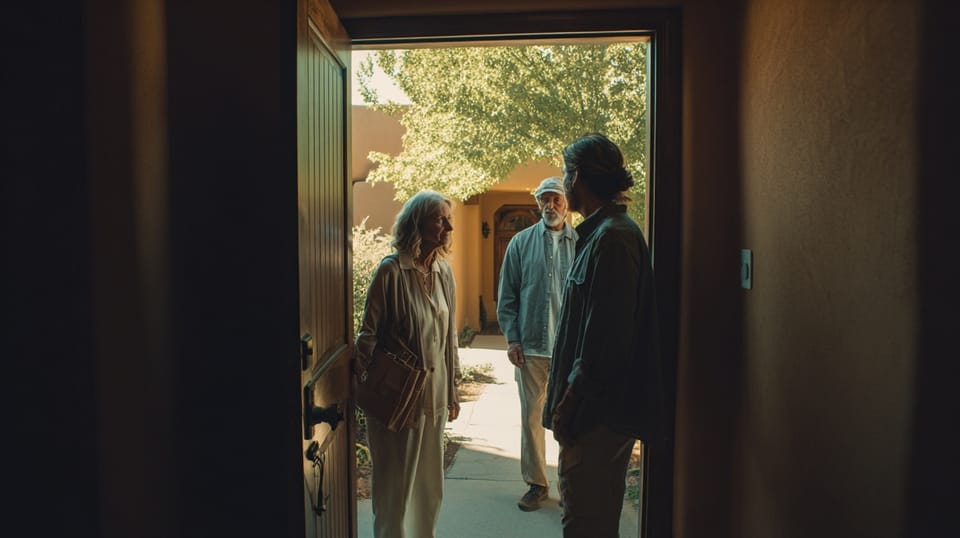
Companion Living as an Emerging Social Technology of Aging
I’ve been thinking lately about a space that doesn’t have a good name yet.
It’s the space between being fine and needing care. Between living alone and moving into assisted living. Between independence and isolation.
Most of us will pass through this space as we age. Some of us are in it already.
And yet, our systems barely acknowledge it exists.
In the United States, eldercare has come to mean one of two things: medicalized care, or privatized housing. Ideally both. Often neither is affordable.
Assisted living costs now routinely exceed $5,000–$7,000 a month, far more in desirable places. I looked into the long term care insurance world, and one hybrid policy (Nationwide) has me plopping down $70,000 - $100,000 now to give me $3000-4000/mo in 16 years at 85. Home care, even at modest hours, can rival a mortgage. The entire market has walked away from perpetual care as elders, even those with signficant memory loss, can live for decades needing day to day care. Meanwhile, housing costs continue their upward climb, squeezing younger workers, caregivers, artists, and service workers out of the very communities where elders want to remain.
These are usually framed as separate crises: a care crisis and a housing crisis.
Policy-wise, they are handled separately too. Different agencies. Different regulations. Different funding streams. Different assumptions about what a “household” is allowed to be.
I’m increasingly convinced they are the same crisis, seen from different ends of the lifespan.
The Invisible Work Holding It All Together
Long before someone qualifies for home health services, there is a great deal of care already happening.
Someone drives you to the appointment. Someone helps you figure out the phone update. Someone notices you haven’t been downstairs all morning. Someone sits with you in the ER, not as a clinician, but as a witness.
This work is everywhere and nowhere in our policy frameworks.
It is not medical care, so Medicare doesn’t see it. It is not skilled labor, so labor law struggles to classify it. It happens in homes, which zoning codes often treat as private, atomic units rather than social infrastructure.
We don’t call it a system because it lives inside relationships. But relationships are doing far more work than our policies admit.
Companion Living as a Social Technology
I want to propose something that sounds modest, maybe even old-fashioned, but which I think represents a real evolution in how we think about aging.
Call it companion living. Or homeshare with support. Or, borrowing from a popular cultural reference, a Golden Girls household.
At its core, the idea is simple:
An older adult with housing shares a home with a trusted companion. In exchange for room, reduced rent, or modest compensation, the companion provides light, clearly bounded support and companionship.
Driving. Errands. Meals. Technology help. Presence. Emergency accompaniment.
This is explicitly not nursing care. And that distinction matters deeply in policy terms.
The moment bathing, lifting, or medication management enters the picture, an entirely different regulatory regime activates: licensing, minimum wages, overtime rules, insurance requirements, liability exposure. Those protections are important, but they also explain why so much care work gets pushed into either institutions or gray markets.
Companion living occupies a different lane. It is about co-living with responsibility, not clinical service delivery.
Seen this way, companion living isn’t a loophole. It’s a missing category.
Why Policy Has Trouble Seeing This
Our current systems assume care happens in one of three ways:
- Inside families, unpaid and invisible
- Through licensed providers, paid and regulated
- Inside facilities, bundled with housing at high cost
What they struggle to recognize is mutuality.
Housing policy rarely accounts for shared households across age unless they resemble student rentals. Labor policy struggles with arrangements that mix room, board, and part-time support without exploitation. Immigration policy tightly controls who can provide care and under what conditions, even as demand explodes.
Ironically, the closest existing policy analogue may be the au pair program: a tightly regulated cultural exchange that allows room and board in exchange for bounded childcare support. It is far from perfect, but it demonstrates something important: the state can recognize live-in, relational care when it chooses to.
Eldercare has never been given a similar imagination.
From Informal to Intentional
Because policy hasn’t caught up, versions of companion living already exist in the shadows.
A short-term house sitter becomes a long-term presence. An Airbnb guest stays “a little longer.” A friend-of-a-friend moves in “for a few months” and stays for years.
These arrangements persist because they meet real needs. They also fail, sometimes painfully, because they lack clarity, boundaries, and shared expectations.
The risk isn’t the idea. The risk is pretending it isn’t already happening.
What makes companion living viable as a future-facing model is intentional design that works with, rather than against, policy realities.
Clear agreements that distinguish companionship from medical care. Defined hours and tasks. Trial periods and exit ramps. Safeguards for both elders and companions.
This is where local pilots matter. Cities and states don’t need to rewrite federal law to begin. They can recognize homesharing as legitimate. Support mediation and matching services. Clarify insurance and zoning guidance. Encourage experimentation without criminalizing it.
Housing Policy as Eldercare Policy
One of the quiet truths here is that eldercare policy is already housing policy, whether we admit it or not.
When zoning restricts unrelated adults from sharing homes, it limits aging options. When tax policy penalizes shared households, it nudges elders toward isolation. When housing subsidies ignore intergenerational models, they reinforce institutional pathways.
Companion living reframes the question. Instead of asking, “How do we pay for more beds?” it asks, “How do we make better use of the homes we already have?”
That is not a radical question. It’s a practical one.
Not a Replacement, But a Bridge
Companion living is not a replacement for professional care. It is not an excuse to underpay labor. It is not a substitute for public investment.
It is a bridge.
A bridge between independence and institutionalization. Between loneliness and belonging. Between housing surplus in one generation and housing scarcity in another.
Policy often lags behind lived reality. This is one of those moments.
The Role of Story
One reason this matters to me, as someone living already in a multi-generational co-housing environment, is that it foregrounds story. One of the things I love about the Commons is the way stories are shared, informally at weekly meals, and formally at our bi-monthly open mic events, the Uncommon Cafe which I co-emcee.
Living together means witnessing each other’s days. Sharing meals. Exchanging histories. Negotiating change in real time.
In an era when AI can generate endless content, the irreplaceable value may be precisely this: lived narrative in shared time. Making stories together.
Companion living is not just a service model. It is a narrative environment. One where elders are not reduced to needs, and companions are not reduced to tasks.
An Invitation, With Eyes Open
What I’m describing here is not a finished program or a policy prescription. It’s a direction of travel.
Communities like Santa Fe, with high concentrations of elders and intense housing pressure, are ideal places to prototype this carefully, ethically, and transparently.
Start small. Document what works. Name what fails. Listen closely to everyone involved.
If eldercare is going to evolve beyond institutions and apps, it will likely do so through these kinds of human-scale experiments, and eventually through policies that learn from them.
The future of aging may not arrive as a device or a facility.
It may arrive as another person in the house, another place set at the table, another relationship that policy finally learns how to see.
What the Rules Say — and Where There’s Room to Experiment
Companion living sits in a space that current U.S. policy doesn’t name very well. That doesn’t mean it’s illegal. It means it requires clarity.
Here’s how the major policy domains typically intersect with models like this:
Labor & Employment
- Light companionship, errands, and household support are generally treated differently than licensed home health or nursing care.
- Clear boundaries matter: bathing, lifting, medication management, and clinical monitoring typically trigger licensing and wage rules.
- Written agreements help distinguish companionship from employment that would require agency oversight.
Housing & Zoning
- Many local zoning codes already allow unrelated adults to share a single household, though definitions vary.
- Homesharing programs operate legally in many U.S. cities by framing arrangements as co-living, not care facilities.
- Cities can support pilots by clarifying that companion living is residential use, not institutional use.
Insurance & Liability
- Homeowner’s or renter’s insurance often covers live-in housemates, but hosts should confirm.
- Companions are not medical providers and should not be presented as such.
- Clear emergency protocols and shared understanding reduce risk for all parties.
Public Programs
- Companion living does not replace Medicare, Medicaid, or home health services.
- It can complement them by delaying or reducing the need for higher-cost interventions.
- Some states and cities already support homeshare pilots through aging or housing departments.
A Useful Analogy The federal au pair program, though designed for childcare, demonstrates that policy can recognize live-in, relational care when it chooses to. Eldercare has not yet received the same policy imagination.
Bottom line: Companion living is not a loophole. It’s a missing category. Pilots help policymakers see what’s already happening and regulate it wisely rather than ignore it.
Golden Threads
My Pilot Concept for Santa Fe
Golden Threads is a proposed pilot model for eldercare homesharing and companionship, grounded in dignity, clarity, and mutual benefit.
It is designed for communities like Santa Fe, where:
- Many elders want to age in place
- Housing costs strain caregivers and workers
- Informal care already fills the gaps
What Golden Threads Is
- A structured homeshare model pairing elders with trusted companions
- Focused on companionship and light support, not medical care
- Built around clear agreements, trial periods, and safeguards
What It Is Not
- Not nursing or home health care
- Not a labor workaround or housing hack
- Not a one-size-fits-all solution
How the Pilot Would Work
Phase 1: Short-Term “Get to Know You” Stays
- 2–8 week stays
- No care expectations
- Trust-building and compatibility testing
Phase 2: Companion Homeshare
- 3–12 month agreements
- 10–15 hours/week of defined support
- Written expectations and exit options
- Regular check-ins
Phase 3: Shared Households
- Two or more elders living together
- One or more companions supporting the household
- Shared costs, shared care, shared life
Core Safeguards
- Background and reference checks
- Clear role boundaries
- Trial periods
- Emergency protocols
- Neutral mediation support
Golden Threads is my conceptual exercise on what something like this could be.
Here's a little digital story imagining my partner Brooke and I, 10 years from now, with our swedish housemate.
Let me know your thoughts as always, joe@storyhost.net.