Wandering into the Fields of Funny: On Humor, Health, and Aging
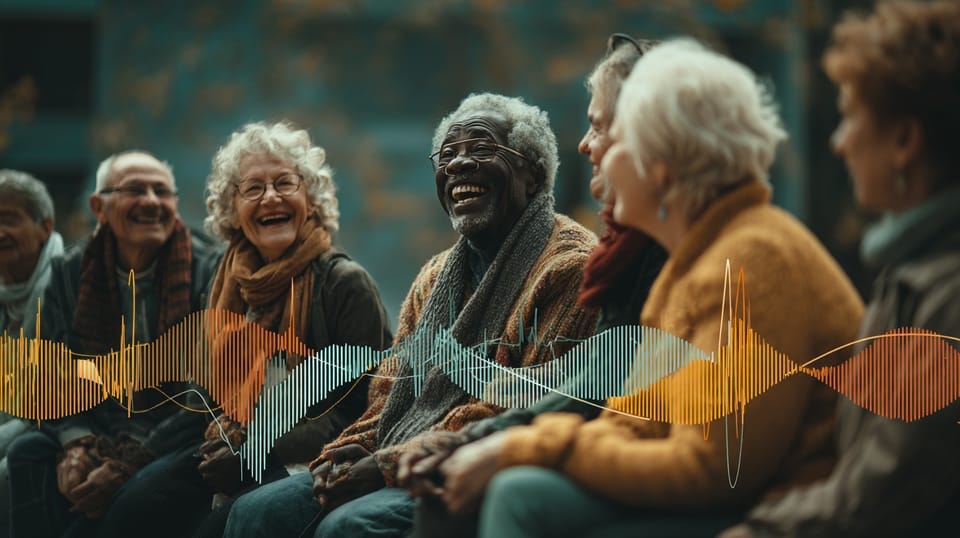
Mel Brooks used to crack that the secret to longevity is simple: “Keep breathing.” Then he’d take a beat, grin, and keep going. It’s an old vaudeville trick and a life practice in one: keep the air moving, especially when grief and change threaten to take your breath away. If you watched him spar, sweetly, with Carl Reiner deep into their nineties, you saw two elders treating humor like cardio for the soul—regular, rhythmic, social.
For years, my participants in our storycenter workshops, have often asked why we don’t have more funny stories. I say, funny is harder than it looks. Funny doesn’t always hold up the way pathos does. I honestly can think of two stories in all the years of my digital storytelling practice that I think as being still funny, one was by the writer/speaker/idea guy Daniel Pink, about a bad day as Al Gore’s speech writer in which in threw up in the now destroyed East Wing of the White House, into a ceremonial dish from Denmark’s queen (titled Sorry Denmark!), and this one about a wonderful working class artist from Wales, My Two Families.
Despite my inability to pull funny out of my storytelling participants, I’ve always loved laughing. My silly streak, my tendency to want to get goofy and completely inappropriate in ways that tickle me, has definitely been one of the ways I kept myself, well, in perspective.
In my prior articles and podcasts, I talked more about the serious business of aging. But we often forget the more human-scale technologies that keep us going: devotion, memory, attention, and, yes, laughter. So, I want to wander into the fields of funny as a way to think about aging well. Not as as a bon bon to chew on while you deal with hard realities, but as a sturdy tool for metabolizing them. And I’ve been thinking about the comics who stayed with us longest—folks like the dearly departed Betty White, George Burns, and Carl Reiner, but also the amazing Dick Van Dyke, Carol Burnett and Mel Brooks who are still with us.
These folks helped me to think about how humor can be the soft handrail we reach for when the stairs get steep.
Below I sketch how the science backs that up, but also how communities, families, and caregivers can make humor a daily practice. Think of it as a field guide for stitching chuckles into the fabric of care.
Cold-open chuckle (and what it’s really doing)
A Mel Brooks one-liner isn’t just a joke—it’s a little breathing lesson. A laugh pulls extra oxygen, lifts your chest, and—if it’s a good one—turns your whole torso into percussion. Then the body settles, heart rate easing, shoulders releasing. That wave is not trivial. Clinicians and health educators have long described how laughter briefly activates the stress response and then helps resolve it, leaving us calmer and better supplied with endorphins—the body’s home-brew pain and mood modulators. You can feel it after a comedy set or a funny phone call: the weather inside you changes.
This is why so many elders talk about “needing a laugh” the way we talk about needing a walk. As early laughter researchers liked to put it, laughter behaves like light exercise for the cardiovascular and respiratory systems—enough to massage the machinery without overtaxing it. The body knows exactly what to do with a joke: inhale, exhale, reset.
The old masters understood this intuitively. George Burns, who played the long game of life and show business, would shrug and say, “You can’t help getting older, but you don’t have to get old.” That line isn’t denial; it’s strategy. Humor is a way to refuse the cramped role culture hands to older people—of shrinking, apologizing, disappearing. When we quip, we take up space again. The laugh restores personhood.
What the body knows when we laugh (a short tour of the evidence)
Let’s glance at the lab bench without losing the music of the thing. For decades, researchers have measured what happens before, during, and after laughter. William F. Fry at Stanford helped establish the field—gelotology—by showing that laughter leads to measurable changes in heart rate, blood pressure, and muscle activity. He called it “internal jogging,” a phrase half corny, half perfect. Later, Lee S. Berk and colleagues at Loma Linda University built out a physiology of mirthful laughter and even the anticipation of humor. Their studies tracked changes in stress hormones like cortisol and epinephrine, shifts in immune markers, and the release of endorphins and dopamine. One of the actionable insights from that stream of work is simple: even looking forward to something funny can start nudging your system out of fight-or-flight.
When older adults are the direct participants, we see a similar story in miniature: small humor interventions—short amusing videos, structured “laughter sessions,” playful group activities—tend to lower perceived stress and sometimes show quick, functional benefits, from pain tolerance to small gains in short-term memory. The studies are not all perfect—sample sizes are often small, methods vary, and the placebo effect is real—but the direction is consistent and commonsense: laughter is a stress recovery tool that most of us already own and know how to use. We only need to remember where we left it.
Importantly, the mechanisms here are communal as much as chemical. We laugh far more in company than alone. The body’s response is braided with the social one: eye contact, timing, a sense of safety. That’s why a joke from a beloved friend lands differently than the same words from a stranger. The laugh is a relational event.
And at the level of everyday practice, this means we can build micro-rituals that make the response more likely: a “funny exchange” text thread with grandchildren; a weekly comedy night at the senior center; a shared notebook of family punchlines. Humor doesn’t have to interrupt care routines; it can be threaded through them like a contrasting stitch.
The kind of humor matters (finding the good stuff)
Psychologist Rod A. Martin gave us a helpful map of “humor styles,” which I translate loosely for caregiving and community life:
- Affiliative humor is the kind that builds bridges—inside jokes that include rather than exclude, playful stories that make a room feel like a family for five minutes. Elders who use affiliative humor tend to report better social connection and well-being.
- Self‑enhancing humor is the inward lens: keeping a wry, resilient perspective on your own foibles. It’s the “I forgot my keys again; apparently they’re auditioning for a role as ninjas” mode. This style acts like bubble wrap around the fragile parts of daily life.
- Aggressive humor takes aim at others—put-downs, barbs, sharpened sarcasm. It can bond one group while wounding another. In clinical and community settings, it often corrodes trust.
- Self‑defeating humor turns the arrows inward, fishing for approval by belittling oneself. We all dip into it, but as a steady diet it’s demoralizing.
For aging well, we should bias toward the first two styles. In a family meeting or a care home lounge, you can feel the difference instantly. Affiliative, self‑enhancing humor leaves people taller. Aggressive and self‑defeating humor makes the room shorter. With elders who carry layered identities—race, gender, class, disability—the stakes are higher. A progressive stance here isn’t about policing jokes; it’s about stewarding dignity. Humor can punch up at systems that harm, or punch down at people who are already carrying the load. Choose the former.
If you’re designing a storytelling or reminiscence session, try cueing humor with prompts that invite warmth and agency: “Tell us about a time you laughed so hard you had to leave the room,” or “Who in your family told the best jokes, and what did they teach you about timing?” Watch the energy shift when the laughs are generous rather than competitive.
Humor across the lifespan (and into the encore years)
There’s a lifespan story here too. Developmental work suggests that as we age, the way we process humor can change—some fast-switch joke structures might land less readily—but our appreciation often deepens. We learn to savor. Gil Greengross’s review of humor and aging points out that older adults may laugh just as much, or more, at material that fits their tempo and context, while perhaps having to work harder on jokes that depend on rapid incongruity resolution. If that sounds like “tell better stories, not just faster ones,” you’re catching my drift.
What’s heartening is that the social functions of humor—bonding, buffering stress, sparking joy—remain robust into late life. In many communities I work with, elders become the keepers of comic memory: the origin stories, the family “bits,” the nonsense songs that get the toddlers giggling and the teenagers rolling their eyes. That institutional memory is a health asset. When a culture tells the same funny story every holiday, that’s not stagnation—it’s a ritual of continuity.
I think often my image of Mel and Carl, trading jokes as they neared 100, checking in with each other at the end of the day. The power there wasn’t just wit; it was regularity and affection. It was grief work too—both men lost spouses and dear friends and had to metabolize that loneliness. The nightly laugh was a pressure valve. So when we talk about humor and aging, we’re also talking about loss literacy. A community that can make room for laughter in proximity to sorrow is practicing a core skill of survivance.
And maybe the chuckles are not sustained over the aging of digital stories I’ve helped to create, but there have been countless priceless moments of mirth in the process, all of which stay with me as the joy of story work. That’s why intentional, intergenerational humor practices matter: the goal is not just to be funny, but to be funny together.
5) Mature defenses, communal joy (what long studies teach)
The long-running Harvard Study of Adult Development offers a companion insight. George Vaillant, one of its stewards, catalogs “mature defenses” that predict healthier trajectories across the decades: altruism, anticipation, sublimation—and humor. By “defense” he doesn’t mean denial. He means a functional, prosocial way of meeting reality without collapsing. Humor, in this framework, is a way to hold pain and possibility in the same palm. It neither sugarcoats nor sensationalizes. It notices the absurdity that suffering sneaks into, and in that noticing, it gives us a few more degrees of freedom.
Overlay that with the study’s headline finding—that warm relationships are the single best predictor of long, happy lives—and the evidence and the elders sing the same tune. The laughs that matter are usually embedded in relationship. We laugh hardest with the people who have seen us at our worst and still show up with a punchline and a casserole. When we build systems of care—home-based, community-based, clinical—we should design for that kind of humor to be probable: shared tables, shared stories, shared attention.
From an equity lens, this is not a luxury add-on. Communities under chronic stress—racialized, economically marginalized, displaced—have long used humor as a mode of resistance and repair. The politics of the joke matters: is it a way to speak truth sideways, bypassing censors and shame? Does it redistribute status for a moment, letting the least powerful in the room own the microphone? The healthiest humor cultures tend to be the least punitive and the most porous—laughter with, not laughter at.
Coda: the storyteller’s lane
As much as the prompt, "tell me a funny story" rarely works, it is still worth thinking that you can teach one aspect of humor. A joke works when it sneaks under our defense systems of expectation. When what we expect, in that terrible trick of timing, is upended by what is delivered. And it works when you know the context of delivery, hence laugh tracks to simulate the idea that you were there when the joke/gag/humorous moment had a social interaction.
Even if your stories don’t provide belly laughs (and I mean intended ones, I’ve had a few that made me laugh in ways I am sure were not intended - no further comment needed), I think the spirit of lightheartedness, of smirk, and wink, cajole and play, all are things I love to hear in the voice of folks providing me with a story. The serious looked at askance, the quasi-tragic framed as ridiculous in retrospect, the mundane examined in a light that delights, all of those attempts are worth at least a smile.
Mel Brooks’s “keep breathing” is the point. While you’re alive, you can laugh. Some days that will feel impossible. That’s when community matters. Keep the air moving for each other. Trade lines. Share the bit. Turn toward the person you love and say, “Tell me something ridiculous.” Accept what comes. Breathe again.
Sources & Further Reading (selected)
- Norman Cousins. Anatomy of an Illness as Perceived by the Patient — publisher page (W. W. Norton). https://wwnorton.com/books/Anatomy-of-an-Illness/
- William F. Fry (Stanford). Early gelotology experiments and physiology of laughter — readable overview in Scientific American, “A Healthy Laugh.” https://www.scientificamerican.com/article/a-healthy-laugh/
- Lee S. Berk and colleagues (Loma Linda University).
- Neuroendocrine/stress-hormone changes with mirthful laughter (Am J Med Sci, 1989) — PubMed: https://pubmed.ncbi.nlm.nih.gov/2556917/
- Neuroimmune modulation during “eustress” of laughter (Altern Ther Health Med, 2001) — PubMed: https://pubmed.ncbi.nlm.nih.gov/11253418/
- “Anticipation” of laughter and mood-related hormones — Nature news explainer: https://www.nature.com/articles/news.2008.741
- Humor & memory in older adults (LLU group). “The Effect of Humor on Short‑Term Memory in Older Adults” — open-access PDF (randomized, controlled trial). https://lluh.org/sites/medical-center.lomalindahealth.org/files/docs/LIVE-IT-Bain-Article-Effect-of-Humor-Whole-Person.pdf
- Rod A. Martin. The Psychology of Humor: An Integrative Approach — latest edition publisher page (Academic Press/Elsevier). https://shop.elsevier.com/books/the-psychology-of-humor/martin/978-0-12-812143-6
- Gil Greengross. “Humor and Aging — A Mini‑Review” (Psychological Topics, 2013) — PubMed record. https://pubmed.ncbi.nlm.nih.gov/23689078/
- George E. Vaillant / Harvard Study of Adult Development.
- Harvard Gazette overview of key findings on relationships and well‑being. https://news.harvard.edu/gazette/story/2017/04/over-nearly-80-years-harvard-study-has-been-showing-how-to-live-a-healthy-and-happy-life/
- “Adaptive midlife defense mechanisms and late‑life health” (J Nerv Ment Dis, 2013) — open-access full text (PMC). https://pmc.ncbi.nlm.nih.gov/articles/PMC3767455/
- Systematic/umbrella looks at humor & health.
- Bennett et al., “Humor and Laughter May Influence Health IV: Humor and Immune Function” (2007) — open-access review (PMC). https://pmc.ncbi.nlm.nih.gov/articles/PMC2686627/
- Yim, “Therapeutic Benefits of Laughter in Mental Health: A Theoretical Review” (2016) — PubMed record. https://pubmed.ncbi.nlm.nih.gov/27439375/
- And of courseCarl Reiner & Mel Brooks on 67 years of Friendship and A classic routine