What Stories Are We Telling About Getting Old?
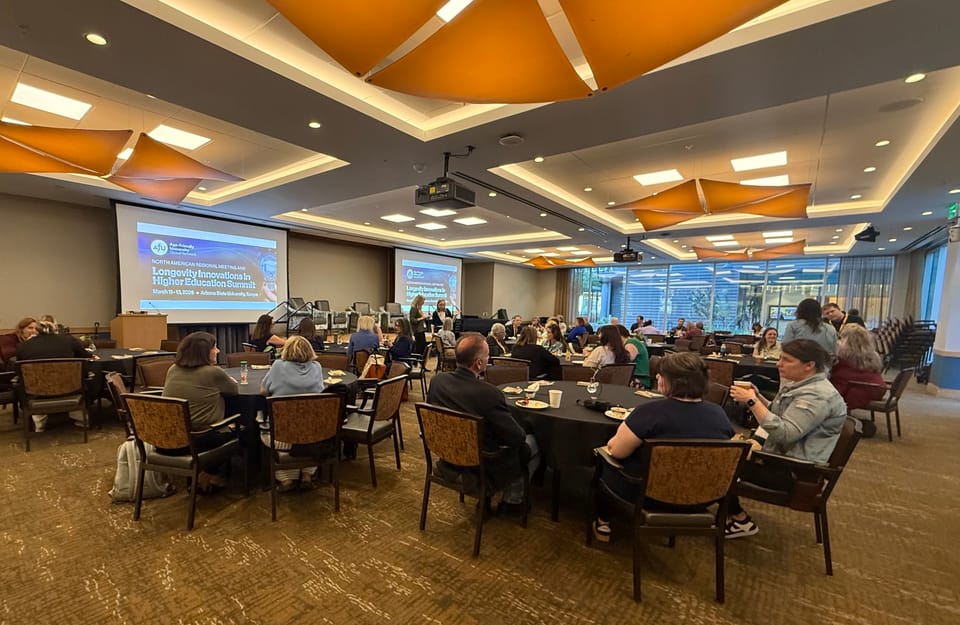
Dispatches from the Longevity Innovations in Higher Education Summit
I'm sitting in the Lifelong Learning Auditorium at Mirabella at ASU — one of the more remarkable spaces I've been in lately, if you think about what it represents. This is a continuing care retirement community built on the campus of Arizona State University in Tempe, literally adjacent to dorms, classrooms, and the thundering apparatus of one of the largest research universities in the country. Residents here, many of them in their eighties, walk across a footbridge to take courses, attend lectures, and sit in the same seminars as twenty-two-year-olds. It's audacious as a concept. And it's thriving.
The occasion is the Longevity Innovations in Higher Education Summit — the LIHE Summit — a gathering of a hundred or so people who are, in one way or another, working at the intersection of aging and higher education. University presidents, gerontologists, architects, program directors, and researchers from a dozen countries have gathered here over three days to collectively imagine what it looks like when universities take aging seriously — not as a peripheral concern, not as a charitable accommodation, but as a central feature of institutional identity and mission.
I came to listen, to learn, and to ask a question that has been nagging at me since I started thinking harder about this world: where is the story work?
Let me back up.
The story we tell about aging in America — and in much of the Western world — is a story of decline, deficit, and departure. You peak somewhere in midlife, and then the long slide begins. You are tolerated, accommodated, maybe celebrated briefly on your way out the door. The cultural metaphors are all valedictory. The images we absorb from advertising, from media, from the casual language of everyday life, consistently frame older people as a burden — on families, on health systems, on the productive economy. This is the master narrative of aging in our time, and it shapes policy, architecture, curriculum design, and the interior lives of the people it describes.
The scholars and practitioners gathered here this week are pushing back against that narrative. Hard. And they're doing it not only at the level of program design and policy advocacy, but — and this is what interests me most as a story worker — at the level of language itself.
One of the breakout sessions I attended was called, pointedly, Words Matter: Reframing Aging to Build Age-Friendly Universities, led by Hannah Albers of the National Center to Reframe Aging, alongside Rajean Moone from the University of Minnesota and Joann Montepare, a psychologist at Lasell University who also presented in the opening luminary series. The argument was straightforward but consequential: the words we use to describe aging — both in institutional communications and in the casual speech of educators and administrators — carry embedded assumptions that either open doors or close them. "Senior" versus "older adult." "Burden" versus "contributor." "Aging population" as a demographic fact versus a demographic threat. The framing choices aren't trivial. Research in social cognition has established for decades that the stories we tell shape the lived experience of the people those stories are about. Stereotype threat is real. Internalized ageism is real. And universities — institutions whose core business is the transmission of knowledge and value — have an unusual opportunity and responsibility here.
This reframing impulse ran through the entire summit. Eunice Nichols of CoGenerate, one of the Luminary presenters who kicked off Day One, spoke about intergenerational connection not as a feel-good add-on but as an organizing principle for institutional culture — proximity, purpose, and partnership as the pillars of what she called "the future of together." Simon Chan of the NEXEL Collaborative framed the midlife years themselves as an underserved and growing opportunity for higher education, a cohort that universities have historically ignored while scrambling to serve eighteen-year-olds. And Céline Abecassis-Moedas, Pro-Rector for Innovation at Universidade Católica Portuguesa, brought a genuinely international perspective, arguing that longevity is one of the defining design challenges of the twenty-first century — and that universities that treat it as such will have a meaningful role in shaping the century.
None of this is small.
The physical context matters too. Andrew Carle, founder of UniversityRetirementCommunities.com and arguably the person most responsible for defining and popularizing the university-based retirement community (UBRC) as a distinct model, gave both a pre-conference deep dive and a Luminary presentation on the movement he has spent two decades building. The idea is elegant: universities have land, mission, student populations in need of mentorship and real-world learning, and alumni who want to remain engaged. Retirement communities need financial sustainability, programming, intellectual vitality, and connection to the larger culture. The alignment, once you see it, seems almost obvious — though Carle will be the first to tell you that the partnership structures, financial models, and governance questions are anything but simple.
Mirabella at ASU is one of the most successful examples of the model in operation. Lasell Village, outside Boston, is another — now over two decades old and in many ways the template. Representatives from both were here, including Zehra Abid-Wood, President of Lasell Village, who spoke in a breakout about what it actually means to run a learning institution without graduation. The residents are the students; the students are also, sometimes, the teachers; and the boundary between the campus and the community is, by design, permeable and generative.
I was struck, sitting through these sessions, by the genuine energy in the room. These are people who have found a frame that makes the work feel urgent and hopeful at the same time. The aging of the population is, in the conventional narrative, a looming catastrophe — a tsunami of dependency crashing onto an overstretched healthcare system. The people gathered here are telling a different story: that longer lives, lived well, can be a resource. That intergenerational connection benefits everyone in the exchange. That the university, whatever else it may be, is one of the few remaining institutions in American civic life that can hold together multiple generations in common pursuit of something larger than commercial transaction.
I believe that story. But I also kept asking: where are the storytellers?
One synergistic example came in a breakout session on Thursday afternoon, tucked into the third workshop block, almost at the end of the formal programming. It was called Sesame 3 Generation Mentoring: Inspiring Joy and Community on Campus, and it was led by Anne Marie Santoro and Andrew Goldberg of 3G Mentoring — an initiative born from a remarkable collection of Sesame Street alumni who decided that the thing they knew how to do, which was make genuine human connection across difference feel safe and possible and joyful, was exactly what the loneliness crisis demanded.
The project was initiated by Lew Bernstein who retired after forty-three years at Sesame Workshop — he was Executive Producer of Sesame Street and Executive Vice President of Education Research and Outreach, among other roles. He spent some of his post-Sesame years obsessed, as he puts it, with what he frames as the most serious public health threat of our time: not cancer, not heart disease, but loneliness and social isolation, particularly among elders, teenagers, and young children In the middle of the pandemic, knowing just how brutal the pandemic was for children, teens and elders, he came up with this program. . The 3G program uses classic Sesame Street segments as springboards for guided, interactive discussion among participants across three generations. The model is piloted in New York, Los Angeles, and Texas, and they are working to scale it nationally.
Anne Marie Santoro, who spent a decade at Sesame Workshop designing national training programs before founding From the Heart Communications, described the facilitation approach with the kind of practiced clarity you get from someone who has thought very hard, for a very long time, about how to create the conditions for genuine human sharing. Safe space. Gentle facilitation. Joyful prompts that lower the defensive architecture people build around themselves, especially across generations that have been trained to see each other with suspicion or incomprehension. And crucially: the development of participants as peer facilitators themselves — leaders who emerge from within the community rather than being installed from without.
This is parallel with the methodology StoryCenter has been developing and refining for four decades. What it share with the Digital Storytelling workshop model — the circle, the story, the careful attention to voice and image and what it means to witness — is built on exactly these principles. Safe space. Witness rather than judge. The story as a bridge not only outward to an audience but inward to oneself. And the long-term investment in building local facilitation capacity rather than flying in experts.
The 3G session was where I found a facilitated community arts practice as a methodology for building intergenerational community. I am confident that there are countless engagement processes, and certainly life writing and autobiography is the heart of many programs in these communities. But in this rather high level discussion on the state of the art of University-based retirement communities, the role of storytelling seemed absent. As someone said about gaps in general, they should be viewed as opportunities. And so the lack of story’s role even in the strategic endeavor of this conference, is something to pursue.
Then came the final day.
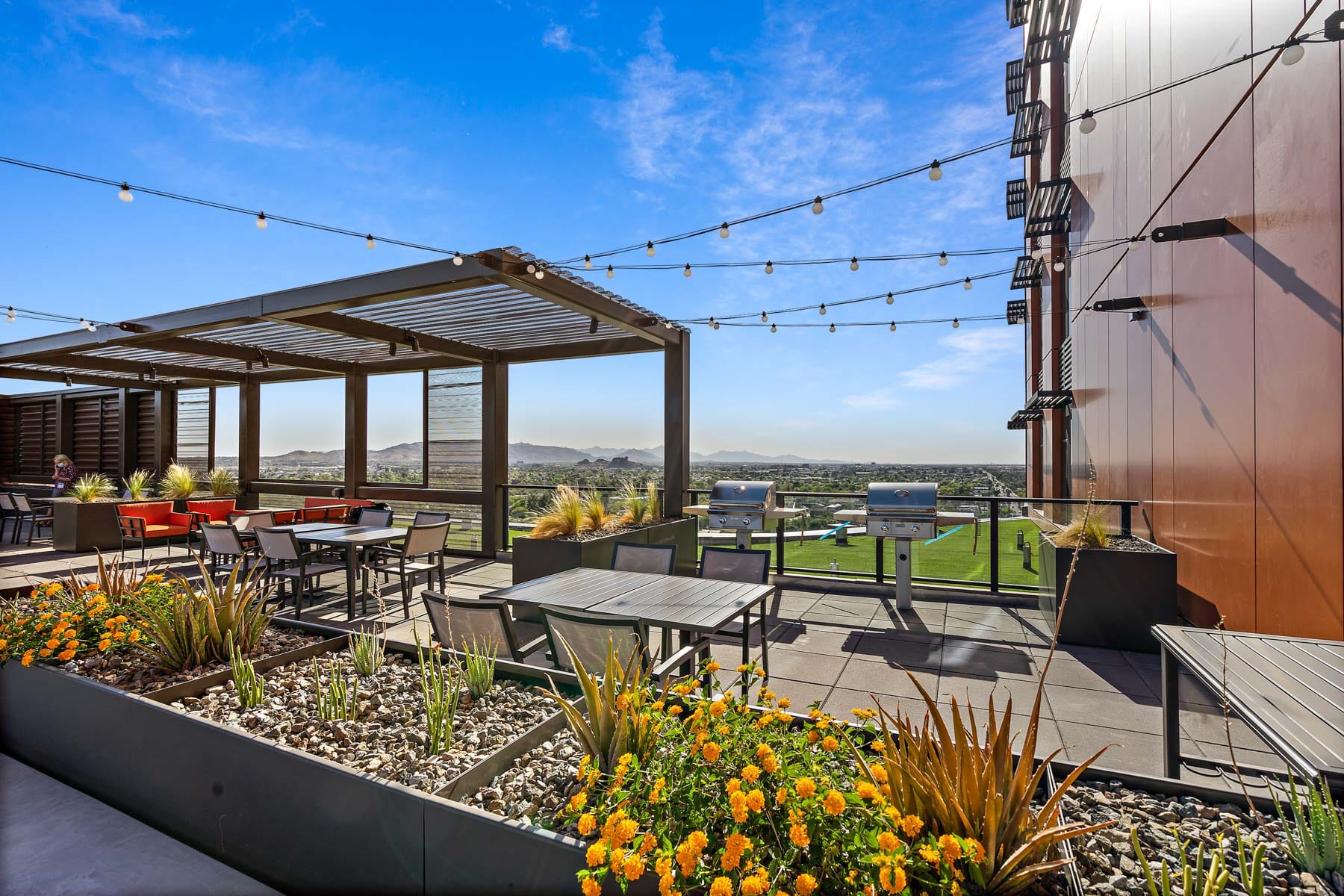
Dr. Leanne Clark-Shirley of the American Society on Aging, started with a story. About Mary, who had led her and a small group on the tour of Mirabella building the prior afternoon. In the story she shared Mary's sense of playful autonomy, she took them to the woodshop, apparently not on the tour. Where Leanne noted the tree limbs in one of the collections of wood, "whose is that?" she asked. "Mine" Mary answered, "I collect them and turn them into these type of bowls or other objects," showing them some of her artistic efforts. Leanne noted she also was a tree branch and twig collector. The same happened as Mary took them to the roof, again, not on the "official" tour to show them rooftop garden and the flowers she loved. Leanne noted she loved the same flowers. At some point Mary told the group, that despite the joy she was finding living at Mirabella "This is the hardest thing I've ever done."
Leanne got it. Leaving your home, going to a new place, making your life work surrounded by new people. It is hard. It is filled with friction. University's play a critical role in managing friction and change for young people, it only makes sense they would be good at managing change in other parts of life.
Leanne made the point that all life transitions share these friction heavy experiences. She re-framed the moment as one of extraordinary opportunity — what she called "the opportunity of lifetimes."
She continued to talk about "naming the villain" as a narrative strategy for her work with council on aging, the villain being age segregation, and that we needed, on top of encouraging age friendly, age inclusive and age diverse environments, we needed age integrated environments as a central conceptual frame.
It was a good talk. But mainly I remember the story. I told her afterward that I thought it was one of the more effective and disarming talks I had heard, because the story had a deep sense of connected awareness, and it was fresh. She of course had written it that morning, with the details in mind, and the meaning and insight came shining through organically.
To quote Alyssa Liu coming off the ice last month, "That's what I'm f**king talking about." That's the magic of story.
The rest of the morning was given over to a futures-thinking workshop designed to help participants imagine aspirational institutional scenarios, led by Ruth Wylie of ASU's Center for Science and the Imagination. She also centered story, and the stories we tell, as central to the project of imagining futures. She reminded us the ways that speculative fiction in books, television and film helped push forward the realization of countless new technologies. And she the stories of the work of her center were beyond inspiring, projects like:
Project Hieroglyph founded by bestselling science fiction author Neal Stephenson - collaboration between writers and scientific researchers.
In their Climate Imagination / Everything Change , they hosted the likes of Margaret Atwood (2014), Paolo Bacigalupi (2015), Kim Stanley Robinson (2017), and Omar El Akkad (2019).
Solar Tomorrows produced two books — The Weight of Light (2019) and Cities of Light (2021) — tracing pathways to possible solar and solarpunk futures.
And The Applied Sci-Fi Project,which brought together science fiction writers, futurists, scholars, and technologists to survey how science fiction narratives shape the development of real-world technologies — mapping what they call the "Sci-Fi Feedback Loop."
Her presentation led to a four part workshop built around the idea that we all carry assumptions about the nature of a given thing in the world, like a book. We see it as a bounded paper object of a given size and shape, but we know books can be countless things beyond our first blush reactions. She gave us, in our assorted 6-7 groups around the tables in the conference room the task of discussing the question"
"What if Universities were not principally focussed on serving 18-22 year olds as institutions?"
We then went through considering options and ideas at our table.
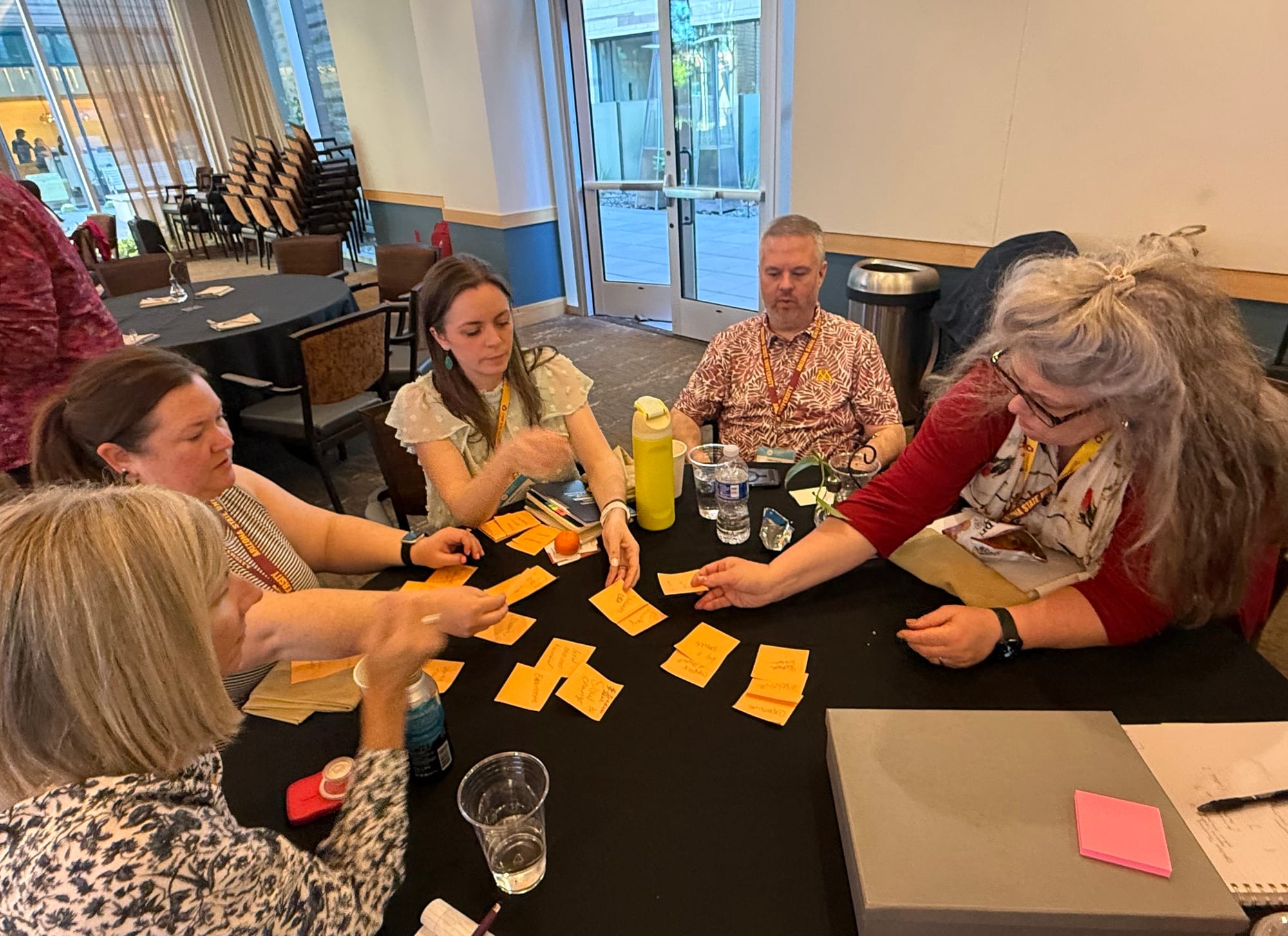
She asked us to consider possible future's across the Probable, Plausible, Possible, Preposterous spectrum. Then to describe what that future might look like, and jointly agree on a six word story for our imagined future. And finally to imagine, with a little kit of craft supplies, an object from the future. Here are some of the outcomes.

And of course my table created inclusion specs allowing us to see past all our confirmation bias to hold an age integrated perspective in the year 2046.
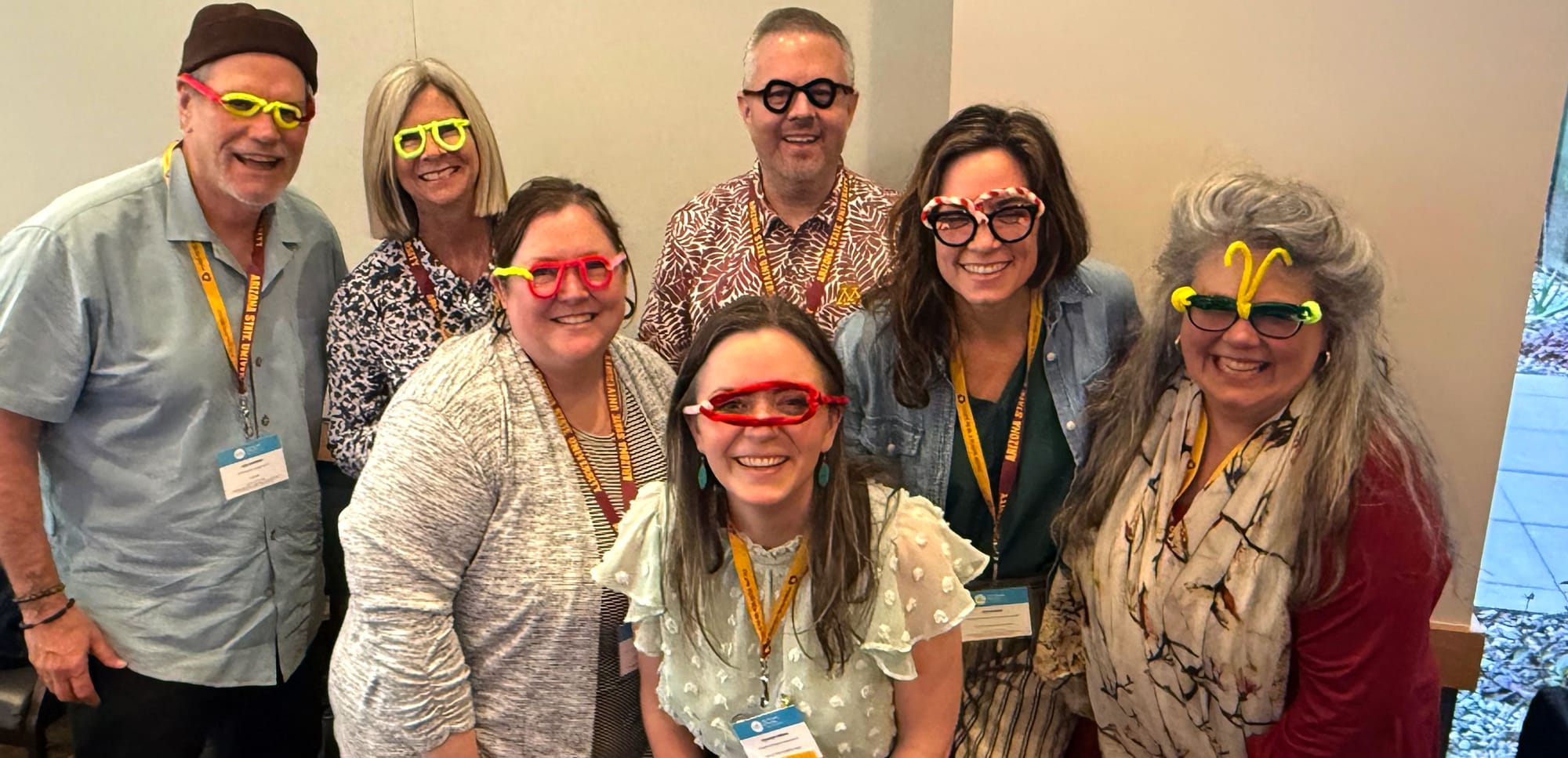
As you can tell, we were quite serious about our efforts.
I came away from the day and a half experience quite motivated to learn more about this world of university-based retirement communities, and with my own aspiration, the university-based intergenerational co-housing community modeled on my own experience here at the Commons in Santa Fe.
And I walked away hopeful that the stories we tell about aging are changing. Slowly, and with tremendous institutional resistance, but they are changing. The LIHE Summit is one gathering among many where people are doing the hard work of reimagining what it means to grow old in an institution that takes that process seriously. I'm hoping to re-connect with a number of these people, and have them join my Elderware podcast. And I certainly hope I can encourage a sharper sense of how the narrative turn — the actual practice of story — might find a more central place in this work.
I have to shout out that my presence at the conference is owed completely to the generosity of Lindsey Beagley, the Senior Director of Lifelong University Engagement at Arizona State University. And she was the hostess-with-the-mostess of the event, so all of us owe it to her and the team at ASU for making this gathering such an invigorating event.
P.S. Here is the future story Lindsey created with me for the 100 years Conference last month. Rising Up Together: The Intergenerational Campus