Freedom, Independence, and the Art of Getting Older

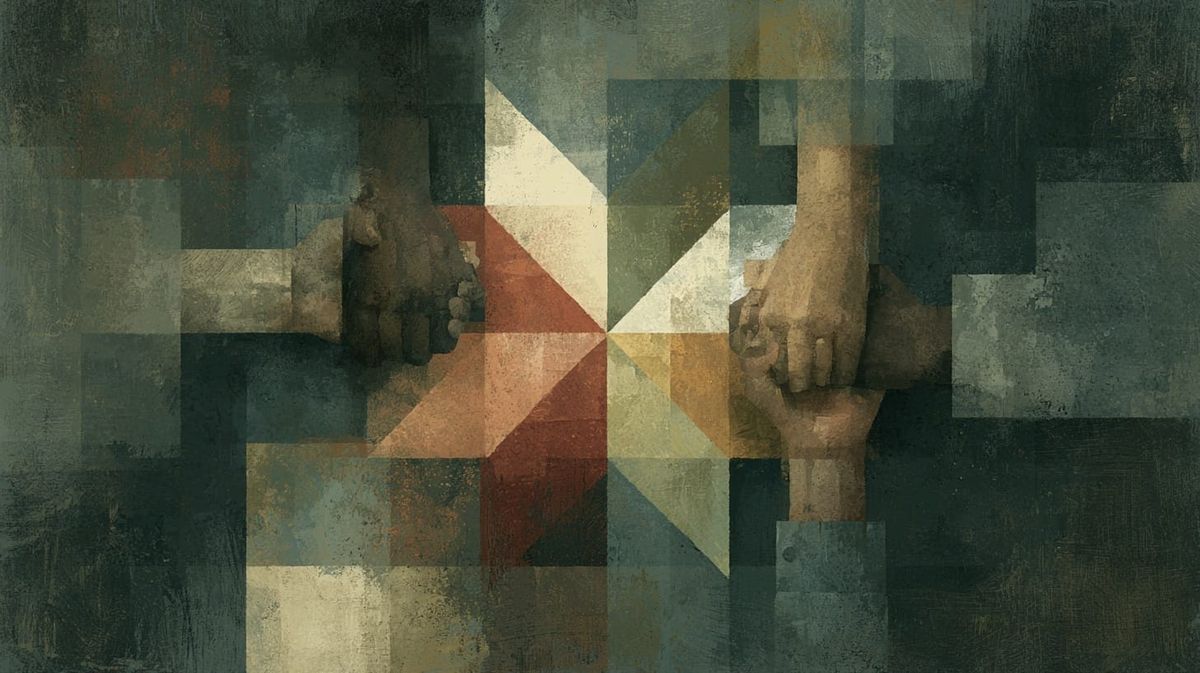
A meditation for the Fourth of July, or any day you're feeling it
I grew up in a house where "freedom" was not an abstraction. My parents — George and Latane Lambert, labor organizers and civil rights workers in the Texas tradition — threw the word around like a tool, which is exactly what it was. Freedom to organize. Freedom from want. Freedom as something you built with other people, not something you defended alone on a hilltop with a rifle.
So it has always puzzled me, in the way that only the most important confusions do, how the same word can mean such radically different things depending on who's saying it and which way the wind is blowing.
Take the Fourth of July. We're about to have one. American independence: the grand experiment, the idea that consent of the governed actually means something, that there's a difference between liberty and license, and that a bunch of colonial farmers could tell the most powerful empire on earth to go sort itself out. Stirring stuff. I'm still moved by it, honestly, even as a reconstructed Marxist who knows the document had some extraordinary loopholes.
But here's what I've been thinking about lately, walking into my seventh decade: the word "independence" does a lot of strange work in American life, and not all of it is honest.
The social psychologist Jonathan Haidt has spent years mapping the moral foundations that underpin different political orientations, and one of the things he's found is that Americans across the political spectrum care about liberty — but they mean different things by it. Conservatives tend to emphasize freedom from: from government overreach, from mandates, from being told what to do. Progressives tend to emphasize freedom to: to access healthcare, to participate fully in civic life, to not be crushed by circumstances of birth. Both are real values. Both contain genuine wisdom. Both, carried to their logical extreme without the other, produce a pretty bleak world.
What Haidt's framework inperfectly, but usefully illuminates — and what I think is relevant beyond the political food fight — is that these aren't just policy disagreements. They're different accounts of what a person fundamentally is. The conservative vision tends toward the sovereign individual, self-made and self-sufficient, owing nothing to nobody. The progressive vision tends toward the embedded social being, shaped by community and history, whose freedom is always already relational.
I spent decades working in community arts and popular education, which puts me pretty clearly in one camp. But I'll tell you something: the older I get, the more I think both camps are missing something, and it has to do with how we actually experience growing old.
Here's the cultural image we've been given for aging with dignity: Clint Eastwood squinting into the sun. The rugged individual. Don't need anybody. Handle my own business. Still fast on the draw. The fantasy is that you age into a kind of distilled self-sufficiency — that the accumulated competence of a lifetime means you need less and less from the world, until you're a self-contained unit of pure capability, needing nobody, imposing on nothing.
It's a powerful image. I get it. I've got some of that in me too — the stubborn refusal to ask for directions, the conviction that I can figure it out myself, the slight pang of something whenever I have to admit I can't.
But I also live in a co-housing community. I know my neighbors' names. I know their schedules and their struggles and who's got a lemon when I need it. And what I've learned, living in actual intentional proximity to other people across different stages of life, is that the Golden Girls had it right too.
Four women, a house in Miami, a cheesecake in the refrigerator, and each other. Not as a consolation prize for the independence they'd lost. As a choice — a different account of what a good life looks like. Mutual aid not as failure but as flourishing. The recognition that autonomy and interdependence aren't opposites. They're a conversation.
Gerontologists have a concept they sometimes call "successful aging," and it used to be defined almost entirely in negative terms: no disease, no disability, no cognitive decline. The absence of dependency. Which tells you something about how deeply the Eastwood model is embedded in how we think about growing old.
But that framing is changing, slowly, as researchers and practitioners actually listen to older people talk about what makes their lives feel meaningful and good. And what comes up, over and over, is not self-sufficiency. It's connection. It's purpose. It's the feeling of being known by someone who genuinely gives a damn. It's reciprocity — the ability to give as well as receive, to be needed as well as to need.
Autonomy matters enormously in later life. Agency matters. The ability to make decisions about your own body, your own time, your own meaning. The research on what happens to people when their agency is systematically stripped away — in institutional settings, in relationships of care that tip over into control — is grim reading. We should fight, hard and smart, for the conditions under which older people retain genuine self-determination.
Self-determination is not the same as self-sufficiency. You can be deeply, genuinely autonomous and still need help carrying the groceries. You can be the author of your own life and still depend on your neighbor to drive you to the doctor. Independence, in the meaningful sense — freedom to make choices that reflect your actual values, to live according to your own understanding of what matters — is entirely compatible with radical interdependence.
The Eastwood image conflates two things that don't need to be conflated. It says: needing others is weakness. Which is not only empirically wrong — human beings are the most interdependent species on the planet, and our genius is precisely our ability to cooperate at scale — but it is actively harmful as a guide for how to age well. It leads people to refuse help until the situation is dire. To isolate rather than connect. To mistake stubbornness for dignity.
My mom knew something about this. She understood that the civil rights movement, the labor movement, the whole grand project of expanding human freedom — none of it was done alone. Freedom, in that tradition, was always something built together. The individual mattered, fiercely. But the individual was always also embedded in a community of struggle, care, and mutual obligation.
When she passed away in 2001 I interviewed her two best friends, Venola Schmidt and Ruth Ellinger. They had been listening to each other for 60 years. Knowing each other like sisters do. The next week Venola passed away. As if, without her mutual partner in radical activism, in holding space for each other, might as well hang up her spurs.
That's the account of freedom I want to carry into my own aging. Not Eastwood squinting into the sun, though I'll keep a little of that, for flavor. But a life in which I know my neighbors, ask for what I need, offer what I have, and understand that the web of connection I'm embedded in is not a constraint on my freedom but its actual condition.
Independence Day, in that reading, is every day you choose, with full awareness and genuine agency, to be in real relationship with the people around you.
Cheesecake optional. But strongly recommended.