
The Adults in the Room (Finally)

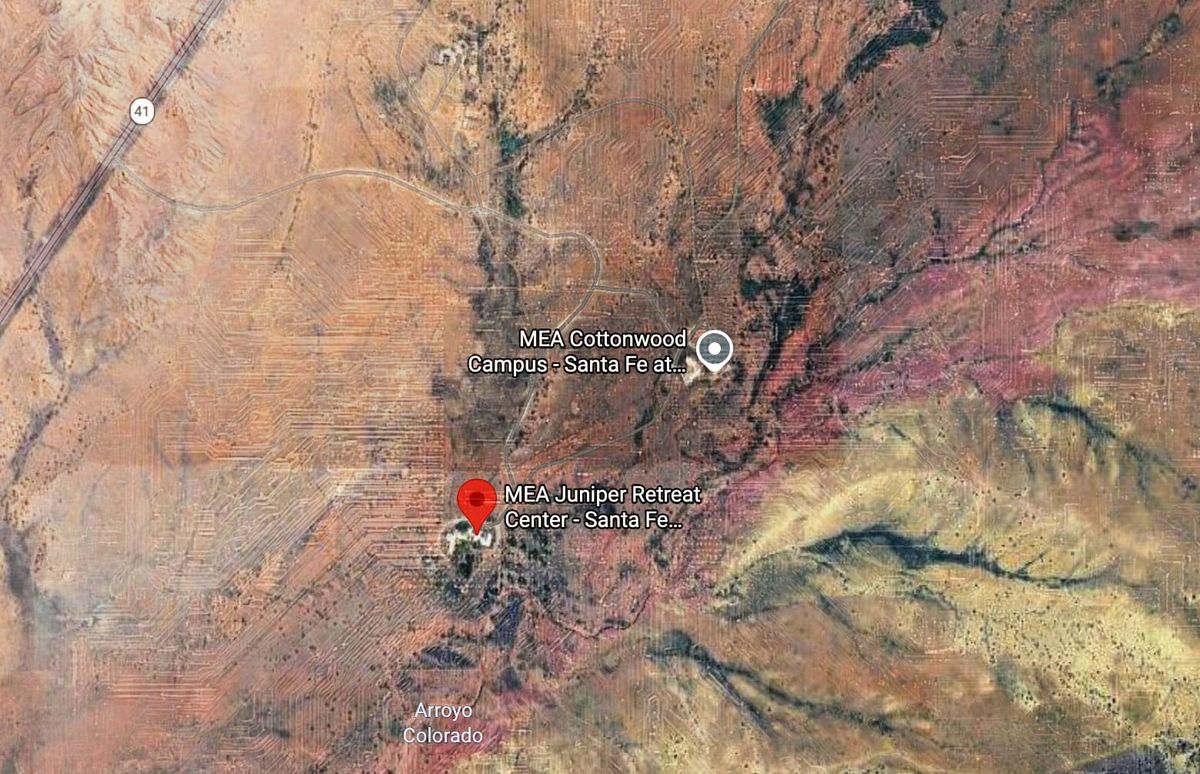
Last week I drove with my fellow commoner Rosy south of Santa Fe near Galisteo to Rising Circle Ranch, the Modern Elder Academy's high-desert campus, to see Chip Conley. Four square miles of arroyos and horses and Pueblo-Revival architecture, thirteen miles of hiking trails, a silence so complete you can hear your own knees creak, which is louder all the time. Chip built it as a place to reframe midlife — Golden Girls energy instead of crisis energy — and it works.
But what I kept thinking about, wondering around the campus, wasn't midlife.
It was 1987.
That's the year Chip, twenty-six years old and fresh off a real estate disillusionment, borrowed a million dollars and bought a decrepit motel in the Tenderloin and turned it into the Phoenix — the rock-and-roll hotel where David Bowie and Linda Ronstadt and half of Rolling Stone's mailing list came to stay. I was a few blocks away at Fort Mason, running Life on the Water, producing theater with a rotating cast of people who were, all of us, figuring out how to make something out of nothing in a city that hadn't yet decided what it was becoming. Chip was our hotelier of choice when we needed to put up a visiting artist who required, let's say, a certain psychographic. We didn't know yet that we were watching the opening act of something enormous.
A few miles north, in Sausalito, Stewart Brand and Larry Brilliant had started something called The WELL — a dial-up bulletin board where Deadheads and journalists and homesteaders argued about everything at two hundred baud. Down the peninsula, people were unboxing the new Macintosh SE, a beige box with a nine-inch screen that felt, at the time, like science fiction. I was an early WELL participant, and my theater ran on a couple of those SE's. But nobody in that scene — not Chip building his hotel business, not me building theater seasons, not the WELL's cranky philosophers — had any real sense that the toy in the beige box and the bulletin board in Sausalito were the DNA of something that would someday require heads of state to sit down together and negotiate.
That's where we are now.
And this month, for the first time in a while, there are real signs that somebody's finally acting like an adult about it.
What Actually Happened
Here's the news, stripped of hype: As Anthropic, Open AI, Google, SpaceX leadership floated the idea of slowing down the AI arms race, the US and China are holding direct, dedicated AI safety talks in mid-September, ahead of a Trump-Xi summit on September 24 — the first such conversation. Meanwhile, at the Shanghai Cooperation Organisation summit in Bishkek, China and its partners signed a declaration on AI cooperation covering computing capacity, data centers, and information security — a very different vision, organized around state coordination rather than restraint. And at the BRICS summit in New Delhi this past week, South Africa's president stood up and called for an international mechanism to independently evaluate AI systems, with mandatory incident reporting and human-control principles built in.
None of this adds up to a single global rulebook. What it adds up to is something more modest and, I'd argue, more real: the great powers have stopped pretending this is somebody else's problem. For three years the conversation about AI safety happened mostly in Silicon Valley conference rooms and academic papers. Now it's happening in rooms with translators in them. The frameworks on offer are genuinely different — Washington wants restraint on regulators, Beijing wants coordinated infrastructure, Brussels has already started fining companies under the EU AI Act's new enforcement powers, which kicked in this August. But different frameworks in conversation with each other is a different animal than no conversation at all. That's what maturity in an international system usually looks like at the start — not agreement, but the sides finally acknowledging they're playing the same game.
What This Means If You're Old Enough to Remember Beta Max
Here's why I think this matters specifically for us — the people who've already lived through several complete technology cycles and are watching this one from a slightly different vantage point than the twenty-six-year-olds building it.
We've seen the promise-and-harm pattern before. Every wave — cable television, the internet, social media — arrived promising connection and delivered some of that, plus a set of harms nobody budgeted for, plus a regulatory response that showed up a decade late. AI is following the same arc, except this time the harms landing closest to older adults are specific and already visible: voice-cloning scams that mimic a grandchild's panic, AI companions marketed as loneliness solutions that may or may not actually reduce loneliness but may exploit frail elders, algorithmic decision systems quietly determining insurance and benefits eligibility, and — on the more hopeful side — genuine advances in fall detection, medication management, and the kind of ambient care technology that could let more of us age in our own homes rather than institutions.
The international cooperation, thin as it is, matters because the version of AI governance that gets built in the next eighteen months will decide which of those futures we get more of. A regulatory environment obsessed only with the AI investment race tends to treat consumer protection as friction. A regulatory environment that includes mandatory incident reporting, like what South Africa proposed at BRICS, tends to catch the scam patterns and the discriminatory algorithms before they scale to millions of people. We don't get a vote in Bishkek or at the G20. But we do get a vote in what we demand locally, and that's not nothing. The mid-terms here in the US might be where we speak up the loudest.
The View From Here at Home
Which brings me to the part of this story happening in our own backyard — data centers, policing, and privacy, which have become one of the strangest bipartisan alliances in American politics right now. Protests against AI data centers have spread to more than forty states this year. A Gallup poll this summer found public confidence in big tech companies at a record low, and — this is the part that should get your attention — that distrust is dropping on both the left and the right at nearly the same rate. Twenty proposed data center projects, worth some forty-two billion dollars, were canceled or delayed in just the first quarter of 2026 after local pushback over water use, power costs, and noise.
Layered on top of that is the surveillance question, and this is where it stops being about electricity bills and starts being a civil rights conversation in the fullest sense. Flock Safety's AI license-plate cameras are now installed in thousands of American towns, reading every car that passes, and the ACLU has documented cases of police using that data to stalk women and wrongly accuse people of crimes that never happened. Jay Stanley at the ACLU called the backlash against it a "long-term grassroots bipartisan suspicion" — and having spent my whole adult life in rooms where cultural democracy and civil liberties were the actual subject of the meeting, not the footnote, I recognize that suspicion. It's the same instinct that watched the growth of policing infrastructure in the '60s and '70s and correctly worried about who gets watched, by whom, and what happens to the data. My own parents spent their lives organizing against exactly this kind of asymmetry of power, and it's strange and not entirely comfortable to watch the same argument return wearing a machine-learning costume.
Pro-business political actors argue that heavy AI regulation just hands the race to China, but China sees the same danger, and might lead international regulation policy. The tech industry has poured tens of millions into political action to keep the buildout moving, arguing jobs and growth. The critics — increasingly a coalition that includes rural conservatives worried about their water and power bills right alongside civil liberties groups worried about surveillance — argue that nobody consented to having their town's electricity prices spike or their license plate logged so a chatbot somewhere could get faster at guessing the next word. We'll see how new coalitions vote in November.
What Elders Actually Bring to This Moment
Here's what I keep coming back to, standing in that quiet at Rising Circle Ranch. Chip built his career on reading a room before anyone else could see what the room would become — he saw the Tenderloin's rock-and-roll hotel before anyone else did, and later he saw what Airbnb needed from an older "modern elder" in a company full of twenty-five-year-olds, which was somebody who'd already watched a few cycles of hype curdle into consequence.
That's the actual value proposition of age in a moment like this one. Not nostalgia for the Macintosh SE or The WELL, though I confess to plenty of that. It's pattern recognition. We've seen "this changes everything" before. We know it usually does change everything, just not in the ways anybody predicted at the launch party, and that the bill for the harms tends to come due long after the enthusiasm has worn off and the people most affected are the ones with the least power in the room.
So keep your eyes on the swirling international motion of discussions in the week's to come. It may be remembered as the moments that grassroots power prevented an existential threat to the planet. But equally importantly, watch your own town — the data center hearing, the city council meeting about the license-plate cameras, the local reporting on who's actually making these decisions and who isn't in the room.
That's still where the actual leverage is, for now, and it always has been.
-Joe