The Man With the Mic: Studs Terkel at 114

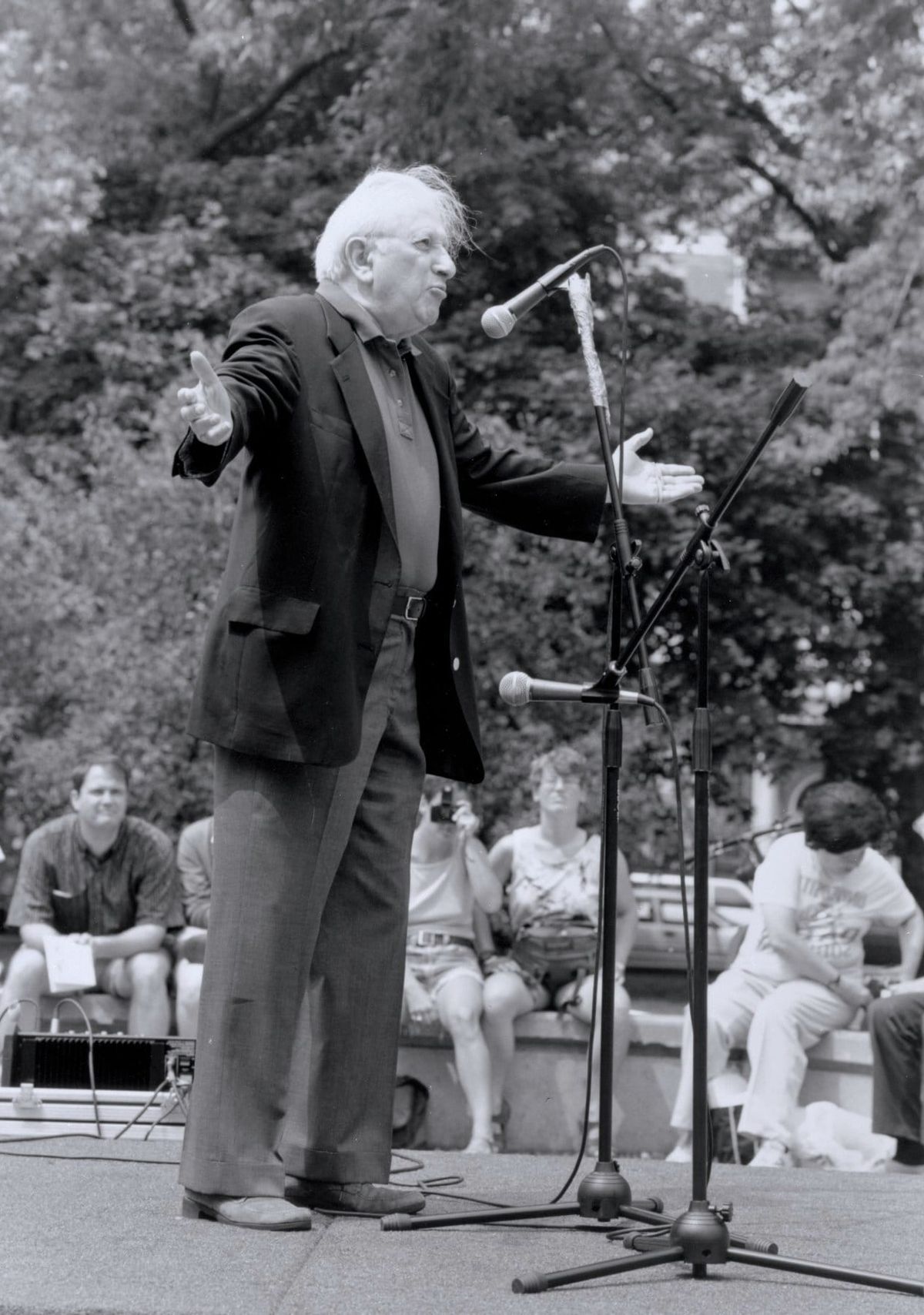
This Saturday, May 16th, Studs Terkel would have turned 114 years old. He was born in 1912, the year the Titanic went down — a fact he loved to cite, usually with that impish grin, as if to say: I came in on the wreckage and I'm still here. He died on Halloween in 2008, at 96, with a copy of his latest book at his bedside. Even at the very end, Studs was still listening.
I've been thinking about him a lot lately.
There's a particular quality to the voices of people who spent their whole lives paying attention to other people. You can hear it — a kind of earned patience, a generosity without sentimentality, the sense that whoever is speaking to them is the most interesting person in the world. Studs Terkel had that quality in abundance. He was, as Cornel West said, "an American treasure." But he was also something rarer: an American elder who never stopped being curious, never retreated into nostalgia, never confused looking backward with giving up on the future.
He was 88 years old when he published Will the Circle Be Unbroken?: Reflections on Death, Rebirth, and Hunger for a Faith (2001). Eighty-eight. He had already written Working and Hard Times and The Good War, had already won the Pulitzer Prize, had already become a kind of living monument to the idea that ordinary people's lives are the real history of a civilization. And there he was, still hauling out the tape recorder, still leaning forward in his chair, asking people the hardest question of all: What do you make of death?
I read through several of the stories recently. The book gathers over sixty voices — emergency room doctors, AIDS caseworkers, a Hiroshima survivor, a woman who returned from a two-year coma, a death-row parolee — regular people and famed ones alike, ranging from the deeply religious to the fiercely atheistic, all asked to speak honestly about mortality. What's remarkable is how alive the book feels. It's about death the way a good wake is about death — with laughter and grief and revelation and the stubborn insistence that the person we're mourning actually mattered. Studs believed everyone mattered. That wasn't a performance. It was his anthropology.
One story stopped me cold: Haskell Wexler. Haskell was always a hero of mine — the cinematographer behind Who's Afraid of Virginia Woolf, Medium Cool, Bound for Glory, one of the great radical artists in Hollywood history. I had forgotten, or maybe never fully knew, about his years as a merchant mariner, the trials that came with that territory during the Red Scare era, the price he paid for his politics. Hearing him in Studs's book — unguarded, reflective, mortal — I was reminded of how many layers a life contains, how much remains hidden even in people we think we know.
That is Studs's great gift as an interviewer. He didn't just get the story people had rehearsed. He got the layer beneath it.
If you want to encounter that gift in its purest form, go to the WFMT Studs Terkel Radio Archive: studsterkel.wfmt.com. It is one of the great public treasures in American cultural life — more than 5,000 conversations, recorded over 46 years on Chicago radio, now freely accessible to anyone with an internet connection. Jazz musicians and labor organizers, poets and politicians, the famous and the utterly unknown, all of them given the same attentive hour.
I've been spending time there lately, and last week I found what I was looking for: a 1974 interview with Maggie Kuhn, founder of the Gray Panthers.
Hearing their two voices together — Studs and Maggie — is something close to a religious experience for those of us who work in the territory of age and story and justice. Maggie Kuhn was then in her late sixties and already on fire. She had been forcibly retired from the Presbyterian Church at 65, and instead of fading gracefully into the background, she had organized. The Gray Panthers were young by then, just a few years old, but already rattling the establishment — challenging mandatory retirement, confronting nursing home abuses, demanding that old people be seen as full citizens with political agency, not problems to be managed. She was fierce and funny and entirely uninterested in being anyone's sweet grandmother.
Studs, of course, loved her for it. You can hear it in how he listens.
What struck me, sitting with that recording fifty-two years after it was made, is how contemporary it sounds. Maggie Kuhn talking about the infantilization of older adults, the way society warehouses its elders, the political potential locked inside aging bodies and long memories — it could have been recorded yesterday. Some things move slowly.
Which brings me to what I really want to say.
What would Studs Terkel say to us right now?
He wouldn't need to be asked twice. Studs, who called American historical amnesia a "national Alzheimer's disease," who understood that democracy is not a possession but a practice — daily, demanding, sometimes exhausting — would recognize exactly where we are. He'd recognize the erosion of institutions, the weaponization of nostalgia, the way fear gets manufactured and distributed like a product. He lived through the Depression and the Red Scare and the blacklists and Vietnam and the long rightward turn, and he never stopped believing that ordinary people, given the chance to tell their own stories, will almost always surprise you with their decency.
That was his political theory, really. Not a party platform. A practice. The act of listening — genuinely listening, without an agenda, with the conviction that what the other person carries is worth your full attention — is itself a democratic act. It is the opposite of the authoritarian instinct, which is always to tell people who they are rather than ask.
He would also be organizing. Studs wasn't a spectator. He rode the bus. He went to the demonstrations. He signed the letters. At 88 he was still interviewing people about dying. At 96 he was still writing. The man had no concept of retirement from the obligations of citizenship.
As someone walking through my own late sixties, I find that — not comforting exactly, but clarifying. The question isn't when we're allowed to stop. The question is what the moment requires.
Right now the moment requires what it always requires from people who know how to listen: that we keep bearing witness. That we keep asking the questions other people are afraid to ask. That we insist, in whatever rooms we have access to, that the stories of the people at the margins are the most important data we have about where we actually are.
Studs knew that. Maggie Kuhn knew that. Their voices are still in the archive, still talking to each other across half a century, still reminding us what it looks like when an elder refuses to be finished.
Happy 114th, Studs.
We could use you something fierce.
The WFMT Studs Terkel Radio Archive is free and publicly accessible at studsterkel.wfmt.com. Start with the 1974 Maggie Kuhn interview. Then don't stop.