Who Are You Voting For, Really?

Age, ideology, and the myth that getting older means getting more conservative
The Folk Wisdom and Its Problems
Let's start with what the research actually says, because it's more interesting than the bumper sticker version.
Folk wisdom has long held that people become more politically conservative as they grow older, although several empirical studies suggest political attitudes are remarkably stable over time. A major longitudinal study using the Michigan Youth-Parent Socialization Panel Study — tracking real people across decades, not just taking generational snapshots — found that the stability of political identity over a lifetime is, in fact, the dominant story. You mostly stay who you were. University of Nebraska-Lincoln
But there's a qualification. On those occasions when political attitudes do shift across the life span, liberals are more likely to become conservatives than conservatives are to become liberals — suggesting that folk wisdom has some empirical basis, even if it overstates the case.
Chicago Booth economist Sam Peltzman pushes the drift argument harder. His research finds that our political beliefs steadily become more conservative as we age, no matter what generation we belong to or what era we grew up in — and that this isn't simply a matter of older cohorts from a more conservative era stacking up on top of liberal youth. If he's right, the drift is real and durable. "All the chatterers on TV are fixated on this idea that young people have gotten more liberal, that they're all socialists now," Peltzman has said. "That's wrong. They're about as liberal, on average, as they have been over the past 50 years — which leads me to believe that by the time they're 45, a lot of this will go away." Chicago Booth Review
That's a bracing prediction. But it raises the crucial question: why would people drift right as they age? The conventional answer — homeownership, retirement accounts, children's college costs, the accumulated compromises of middle-class life — assumes that economic stake-building produces conservative politics. Get a mortgage, and suddenly you care about property tax rates more than climate legislation. Fund a 401(k), and suddenly capital gains tax feels personal.
During the transition from adolescence to young adulthood and middle age, people become increasingly engaged in political and economic matters through their employment and family formation, which results in them being less idealistic but more practical in their political decisions. Once shifted, beliefs may sustain or become increasingly conservative as people age, because there is less room for further socialization and higher economic and social stability as wealth and prestige accumulate. ASA Generations
That's a reasonable description of one kind of aging life. But it's a description that fits a particular demographic, in a particular era. And that era may be ending.
The Parents Hypothesis
Before we accept the drift narrative, though, we should look harder at the other leading explanation: you vote like your parents voted.
Pew Research has found that roughly eight-in-ten parents who identified as Republican had teens who also identified as Republican or leaned that way, and about nine-in-ten parents who identified as Democratic had teens who described themselves the same way. These are remarkable transmission rates — not so different from religion. Pew Research Center
The most frequently found correlation of intergenerational transmission between parents and children is partisanship and religious beliefs. Stronger transmission occurs in highly politicized households with homogenous views on political issues. In other words, if politics was loudly present at the dinner table, you absorbed it. If your family was mixed or quiet on the subject, you had more room to wander. Wikipedia
Although parents may provide the foundation for early political socialization, children's political identities are malleable and influenced by a wide range of outside factors. The classic 1986 Glass study found familial influence to be the dominant force, but that was a different media landscape. Today's picture involves schools, social networks, economic shocks, and cultural watersheds that can realign even well-socialized young adults.
A useful synthesis: you probably started close to your parents' politics, drifted somewhat leftward in your twenties and thirties as you encountered wider worlds and economic struggle, and then — if things went reasonably well materially — drifted back toward your parents as you aged. The arc of a life spent in the middle class. But that's the arc for some people. For others, the material story went differently.
Nomadland Doesn't Vote Like The Villages
Here's where the retirement states become fascinating case studies in contradiction.
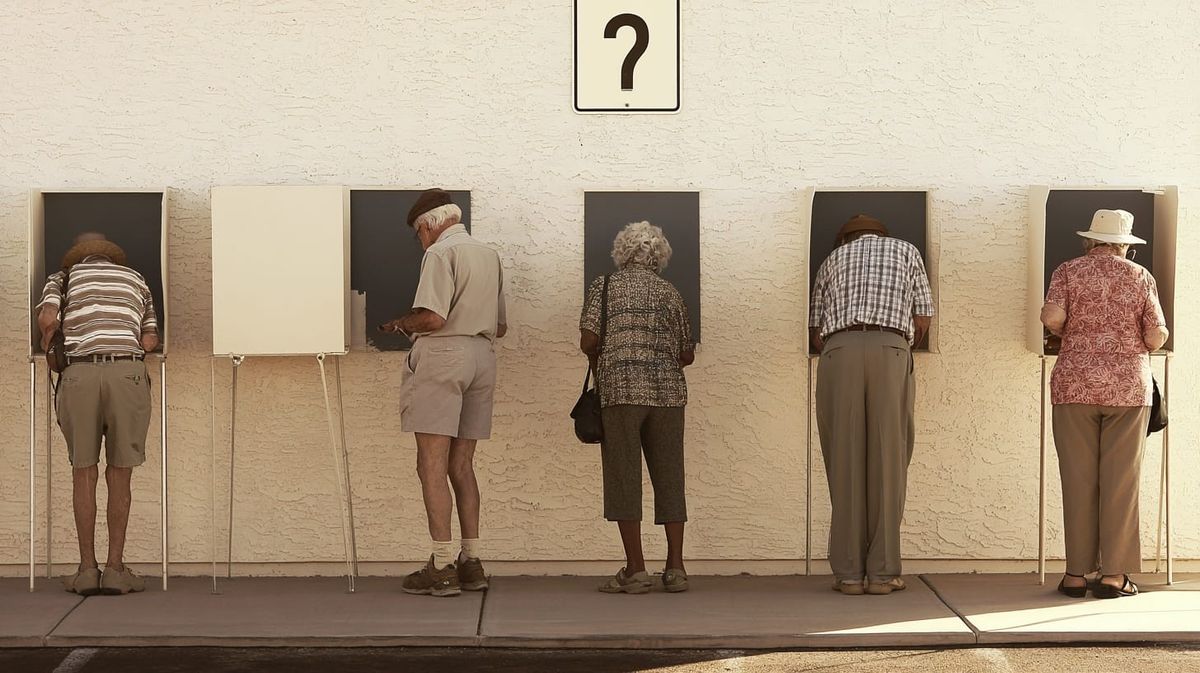
Florida, Arizona, Texas, and California have long been shorthand for the aging conservative vote. The Villages retirement community in central Florida became a kind of meme — a golf-carted convoy of MAGA flags, a concentrated image of old, white, and right. And the aggregate numbers gave that image some support: in the 2016 presidential election, Trump topped Clinton 57 to 40 percent among voters age 65 and up in Florida.
But the picture has been fracturing. By 2020, those margins had tightened considerably. Arizona — once reliably Republican territory — has been flipping purple, driven in part by demographic shifts among retirees who are not your grandparents' retirees. Arizona now has a plurality of voters who no longer identify as Republican or Democrat, a fact that reflects both a younger diversifying population and older voters who are genuinely unmoored from their prior partisan homes. NPR
Why? Because the economic story that was supposed to make older people conservative — accumulated wealth, homeownership, stable pension — is not the story for the majority of American seniors.
Over 19 million older adult households — about 45 percent — do not have the income needed to cover basic living costs. And 80 percent of older adult households, approximately 34 million, are unable to weather a major shock such as widowhood, serious illness, or the need for long-term care. NCOA
This is the Nomadland reality behind the political analysis. Nearly five million older Americans live on less than $1,000 a month, over eight million seniors live in poverty, and older adults are at the epicenter of the national housing affordability and homelessness crisis. And it's not a crisis that arrived suddenly: rising rents, skyrocketing property taxes, and limited availability of affordable senior housing have combined to create a perfect storm for seniors who once expected stability but now face uncertainty about where they will live. Justice in AgingSavingAdvice.com
Compared with prior cohorts, the current cohort of adults at or nearing retirement age faces higher levels of secured and unsecured debt burden from mortgages, home equity loans, student loans, credit cards, and out-of-pocket medical costs. PubMed
If the drift-right thesis depends on property ownership and pension security producing conservative politics, then a generation of renters, debtors, and gig economy retirees should not be drifting right. They should be radicalized — or at minimum, prioritizing economic justice over capital gains taxes. AARP's Nancy LeaMond says it plainly: "You can always count on older voters to be concerned about the economy, and in their world, it's Social Security and Medicare. Those are reliably the most important issues to older voters, no matter what election year it is." AARP
That's not conservative politics. That's a demand for social insurance — the same demand your parents' generation made when they built the New Deal coalition.
What Aging Actually Does to Politics
A common misconception is that political socialization ends in childhood. In reality, it continues across the entire life course. Adults are politically resocialized through significant life events such as economic hardship, war, migration, parenthood, or major political upheavals. Even people who have been politically inactive their entire lives can become motivated to participate as senior citizens, particularly when they encounter issues that directly affect their well-being. Sociology Institute
This is the dynamic that gets lost in the you-get-more-conservative-as-you-age conversation. Aging is not politically inert. It is a series of encounters — with healthcare bureaucracies, with housing markets, with loss, with the question of what kind of society you're handing forward. Those encounters can move people in any direction.
Research suggests that the aftereffects of the 2008 global financial crisis may well have turned millennials into lifelong liberals — those born between 1981 and 1996 adhering more closely to liberal values than prior generations did at the same age. If economic catastrophe can politically form an entire generation in its youth, there's no reason a similar shock in late life — a medical bankruptcy, a lost home, a vanished pension — can't reform political allegiance in the sixties and seventies. Phys.org
The older voter isn't a monolith. The 72-year-old retiree in The Villages and the 68-year-old senior living in a rent-burdened apartment in Phoenix are both "older voters." They are not the same political animal. One has the conservative investments that the conventional narrative predicts. The other has the grievances that historically produce something quite different.
The question worth sitting with, as you watch the primary returns tonight, is not do people get more conservative as they age but rather: which older people, under what material conditions, holding what familial and generational memories?
You probably do vote something like your parents voted. But your parents voted from inside their particular history and economic position — and so do you. The myth of inevitable rightward drift forgets that history keeps happening to all of us, all the way to the end.