The Soundtrack of a Long Life: What Music Does as We Age

How often does a piece of music take you away?
One minute you’re sweating the details of life’s to-do list, and the next you are singing out loud in your car in the gym parking lot.
Okay, that was me today.
Possessed and waves of emotion rushing through me.
Some crazy hoodoo in that experience.
John Prine does that to me.
Someone walking by my car paused to smile at me.
I smiled back.
Music as a Common Theme of Living
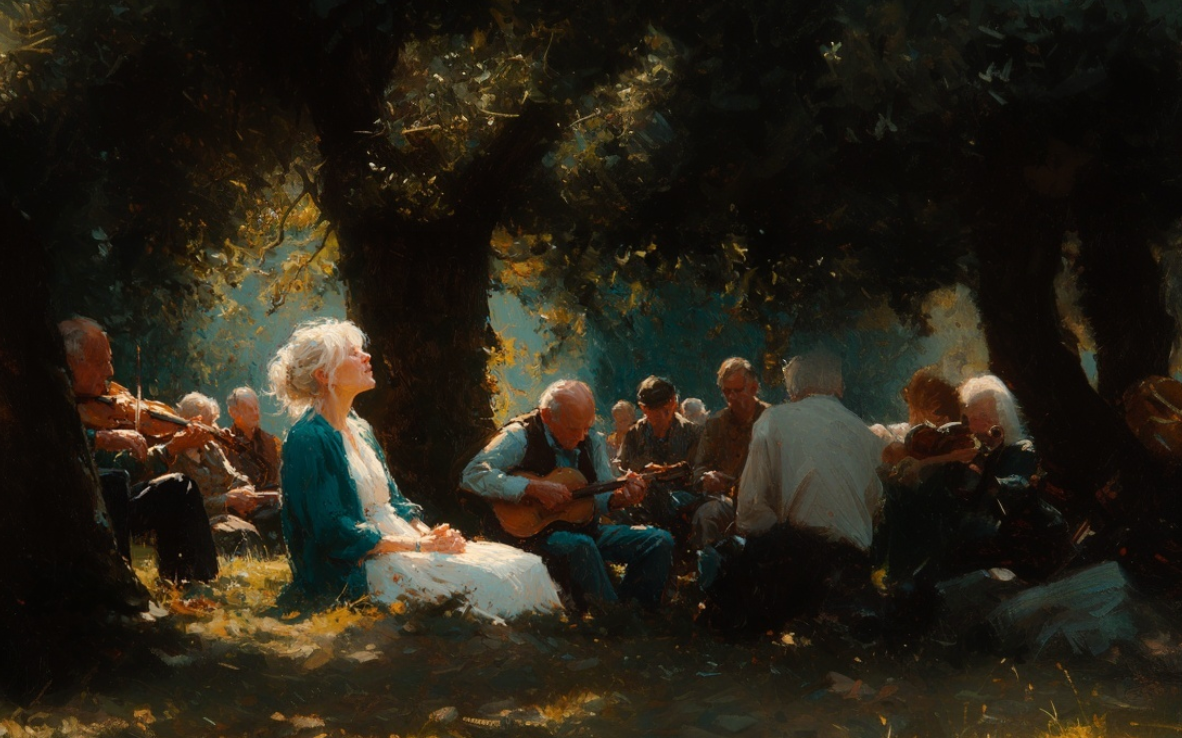
Every weekend at the Commons, since I moved here some 5 years, there is singing on Saturday, and Irish Music on Sunday. I’m not a participant, but whether wandering by on my way out, or into our Common House, I love that life here has a soundtrack.
I walked by one day and I watched an older woman, maybe approaching eighty, just floating off in the groove the reel was exploring. She just didn’t listen, she inhabited the song. Her body shifted, her eyes brightened, and for a few minutes she was somewhere else entirely — and somehow more fully present.
I've been thinking about that person ever since. And thinking about what music actually does to us. Not in a soft, greeting-card way. But biologically, psychologically, socially — in the hard-nosed ways that matter when you're talking about what keeps people alive and living well in the second half of their lives.
Let me tell you what we know.
Memory Lives in the Music
Oliver Sacks spent decades as a neurologist watching music do things that nothing else could. In Musicophilia, his gorgeous exploration of music and the brain, he documented case after case of people with severe memory disorders — Alzheimer's patients who couldn't recall what they had for breakfast — singing complete songs with perfect accuracy, full of emotion, clearly connected to some deeper register of selfhood that the disease hadn't yet reached. He called it "the tenacity of musical memory," and it's more than a lovely phrase. It points to something structural about how music is stored in the brain.
Here's the neuroscience in plain English: music memory is encoded across multiple brain systems simultaneously. It engages the auditory cortex, yes, but also the motor system, the emotional centers (the limbic system and amygdala), and critically, the hippocampus — the seat of autobiographical memory. When we hear a song that mattered to us, we're not just retrieving a sound. We're retrieving a self. A context. A feeling of being alive at a particular moment in time.
Petr Janata at UC Davis has done remarkable brain imaging work showing that familiar music from our past activates the medial prefrontal cortex — one of the last regions to be ravaged by Alzheimer's — and that this activation is directly linked to autobiographical memory recall. The music is a key. The song opens a door to who we were. For people in memory care, this is not a small thing. It's one of the most significant tools we have.
But this isn't just a story about disease. For those of us who are simply aging — navigating the ordinary forgetting, the slower retrieval, the occasional "what was I just saying?" — music functions as a kind of mnemonic infrastructure. It keeps the filing system oiled. It keeps the self-narrative coherent.
The Emotional Thermostat
Music also does something profound for emotional regulation, and this matters enormously as we age. The emotional landscape of later life is genuinely different. Laura Carstensen at Stanford — she developed what she calls Socioemotional Selectivity Theory — has shown that as people age, they tend to get better at managing their emotional lives. They prioritize what matters. They let go of the small irritations more readily. They experience, on balance, more positive affect than younger people, even while facing objectively harder circumstances.
Music is part of how that happens.
Stefan Koelsch, a neuroscientist at the University of Bergen, has mapped the ways music influences the autonomic nervous system — heart rate, blood pressure, cortisol levels — and the immune system. Music we find moving doesn't just feel good; it measurably reduces stress hormones and activates the parasympathetic nervous system, the "rest and restore" mode that our cortisol-soaked world is perpetually trying to suppress. For older adults managing chronic conditions, chronic stress, loss, and the weight of an era that moves faster than anyone bargained for, this is medicine. Not metaphorical medicine. Actual medicine.
There's also what music does for grief. And in later life, we are all doing grief work of one kind or another — losing friends, losing capacities, losing the world we knew. Music has always been the human species' first grief container. Long before therapy, long before language got sophisticated enough to hold loss, there was wailing. There was the blues. There was the lament. Music gives sorrow a form it can move through.
People Who Play
Now let's talk about the musicians among us. The people who kept playing — or took it up late, which is its own remarkable story.
The evidence is fairly striking: musical training and ongoing practice appear to be among the most protective cognitive activities available to aging humans. Nina Kraus at Northwestern has spent years studying what she calls the "musician's advantage" — a suite of neural efficiencies in how trained musicians process sound, maintain attention, and filter noise. These advantages don't disappear with age. In fact, they may become more pronounced in later life, because the musicians have spent decades building what neuroscientists call cognitive reserve — extra neural circuitry that can compensate when other systems begin to decline.
But here's the more democratizing finding: you don't have to have started at five. People who take up an instrument in their sixties or seventies show real neuroplastic benefits. The brain, it turns out, does not fully retire. Learning to play something — anything — activates motor systems, auditory processing, memory, attention, and emotional responsiveness all at once. It's a workout that no single other activity can quite replicate.
Dan Levitin, whose This Is Your Brain on Music helped bring this science to a wider audience, has written about the particular power of music-making as a social activity for older adults. The community band. The choir. The garage ensemble of retired schoolteachers who meet on Wednesday nights. These are not just hobbies. They are neurologically rich, socially embedded practices that operate on almost every dimension of wellbeing simultaneously.
People Who Listen and Dance
Not everyone plays. But listening is not passive, and we should stop treating it as if it is.
Active musical listening — the kind where you're really in it, following the line, feeling the rhythm, letting yourself be moved — is itself a full-body engagement. I think about what happens to me when Ahmad Jamal drops into one of those long, open, breathe-and-wait passages, or when Bill Evans goes somewhere so harmonically unexpected it physically stops you. That's not entertainment. That's an altered state of consciousness achieved through organized sound. That matters.
And dance. Let us not underestimate dance.
The research on dance and aging is among the most exciting in the field. A 2017 study published in Frontiers in Human Neuroscience compared older adults who took up dance with those who engaged in conventional fitness exercise. Both groups showed improvements in white matter integrity in the brain — but only the dancers showed improvements in the hippocampus, that same autobiographical memory center. Dance combines music, movement, social connection, attention, and physical challenge in a way that's essentially unmatched.
There's also the Parkinson's work. Dance for PD — the program developed by the Mark Morris Dance Group — has shown significant improvements in motor control, mood, and quality of life for people with Parkinson's disease. The rhythm of music appears to bypass damaged neural pathways and activate motor function through alternate routes. This is the kind of result that makes you sit back and just be grateful for the human body's stubbornness about wanting to move.
The Social Dimension
I want to end on something that doesn't get said enough in the health literature, because health literature tends to think in individuals and outcomes rather than in communities and meaning.
Music is how we belong to each other.
The concert we attended together. The song that was playing when something happened. The album that got us through a particular year. Music is the connective tissue of shared history, and in later life, when the social world can contract — when friends die, when families scatter, when the roles that gave us identity have shifted — staying connected to music is a way of staying connected to the web of human belonging.
The Commons weekend musical hangouts I described at the beginning of this piece? It wasn't therapy. It was culture. It was people claiming their right to make meaning together, which is, in the end, what I think aging well is actually about.
Play something tonight. Listen to something that wrecked you once and let it wreck you again. Dance in the kitchen if that's all the floor you've got. The research says it's good for you. But I'd argue it goes deeper than that: it's one of the things that keeps us human, keeps us oriented, keeps us here.
And here, for now, is enough.