Who Gets to Grow Old? Family, Belonging, and the Myth We Were Never Part Of
Here in the Commons, we have all types of aging folks. Some with families on site living in old school multi-generational homes, some with kids not too far away, some with kids spread across the country, some built over one long relationship, some blended from several, but we also have a significant number of folks that never had children, probably never wil.
I'was taken aback when I first encountered this statistic: in the United States, adult children perform the majority of informal eldercare. Non-relatives — friends, neighbors, community members — provide only about fourteen percent of care for older adults generally.
Now here's the flip side of that number, and it's the one that actually matters for what I want to talk about today. In LGBTQ+ communities, and of course simply women (and some men) that never chose to be a parent or primary caregiver to someone, that ratio is almost completely inverted. Relatives provide only eleven percent of eldercare. These elders largely care for each other.
Sit with that for a moment. An entire community built a parallel infrastructure of care — not because they were idealists with a vision of how eldercare should work, but because they had to. Because the official version, the one organized around blood ties and legal kinship and the heterosexual nuclear family, simply wasn't available to them. And in doing so, they may have built something the rest of us desperately need to understand.
The phrase "chosen family" has gone somewhat mainstream in recent years, appearing in greeting cards and TV biopics and feel-good Instagram posts. But its origins are anything but soft. Chosen family is, at its core, a refuge specifically generated by and for the queer experience — a form of kinship built precisely because the existing structures of kinship had failed, excluded, or actively abandoned people.
For LGBTQ+ elders specifically, those origins carry particular weight. Present cohorts of older lesbian, gay, and bisexual people are more likely to have been estranged from biological families, less likely to have children, and thus less likely to have access to the intergenerational support that most aging frameworks simply assume is there. These are people who came of age before Stonewall, or just after it — who navigated decades of discrimination, sometimes violence, often invisibility. Who built their support networks sideways rather than vertically, across peers rather than across generations.
And now those peer networks are aging together. One of the structural vulnerabilities this creates is that chosen families in LGBTQ+ communities tend to be made up of age peers, which means when care is needed, the caregivers themselves are often just as old and just as vulnerable. The system works beautifully until it doesn't. Until everyone needs a ride to the doctor at the same time.
This is a design problem. And it's also, I'd argue, a story problem — one of the places where meaning-making and practical survival genuinely converge.
I want to widen the lens here, because the experience of aging outside the nuclear family norm is far bigger than any single community, even as LGBTQ+ elders have been among its most thoughtful navigators.
There are, right now in the United States, something like fifteen million baby boomers who are childless — by choice, by circumstance, or by the complex territory in between those two. This demographic is unprecedented in U.S. history, and it's creating challenges for these individuals as well as for society. The eldercare system was not built for them. Social Security was not designed with them primarily in mind. The cultural script of "your kids will help you figure it out" simply doesn't apply.
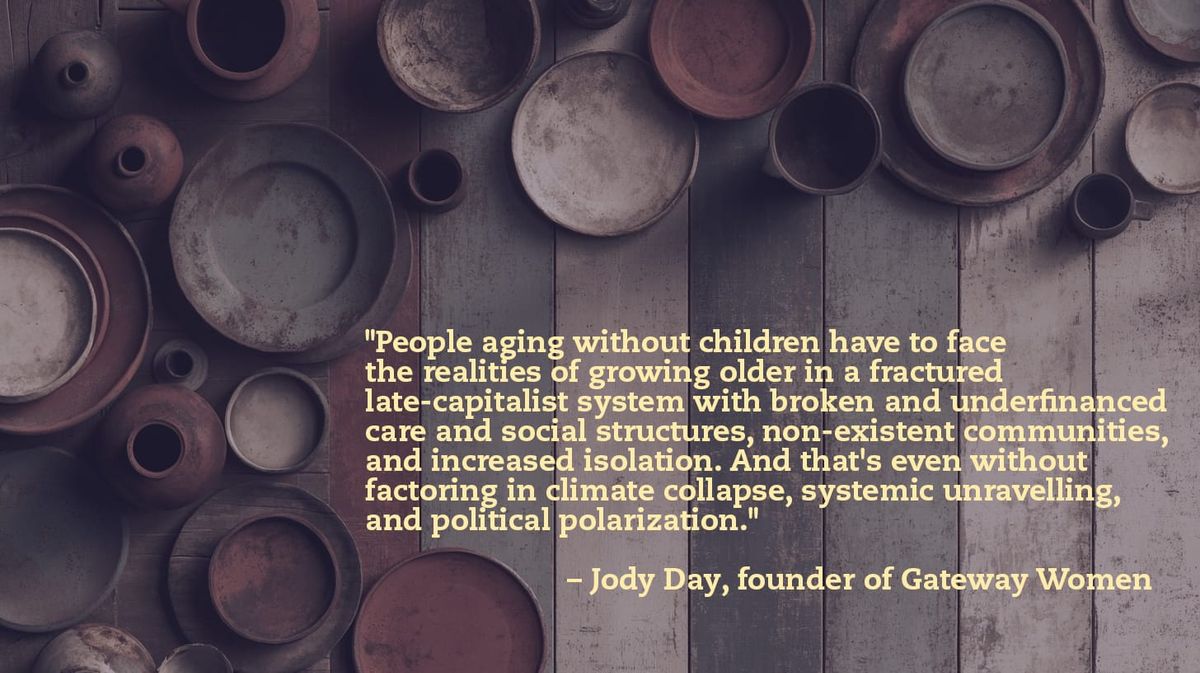
Researcher and advocate Sara Zeff Geber coined the term "Solo Ager" to describe this population — people who are single, or who are partnered but childless, and who know they will largely be navigating their older years without the default safety net that adult children represent. Jody Day, founder of the Gateway Women network and a formidable voice for women who are aging without children, has been building community and intellectual framework around what she calls "childless elderhood" for over a decade — pushing hard against the twin silences of a culture that neither takes seriously women's choices around motherhood nor the specific challenges of growing old without children.
And then there are blended families — the step-children who may or may not show up, the complicated loyalties and competing obligations, the ways that late-in-life partnerships can scramble and reconstitute the whole picture. Blended families, step-families, multi-generational families, people with aging parents or disabled loved ones — all of these configurations have been systematically deprioritized by a legal and policy culture organized around the heterosexual nuclear family as the basic unit of care and inheritance.
Here's where the politics get unavoidable, and I'm going to go there directly.
The moment we are living in is not neutral on these questions. The current political project — and Project 2025 laid it out with unusual candor — is to remove federal protections and empower any entity to prioritize the heterosexual nuclear family over any other family form. We've already seen the Administration for Community Living — the federal agency focused exclusively on aging and disability programs, everything from Meals on Wheels to caregiver respite — proposed for complete dissolution, with programs scattered across the broader health bureaucracy in ways that would make coordination less efficient and could lead to real service disruptions.
For the mainstream aging advocacy community, this is concerning. For LGBTQ+ elders, for solo agers, for anyone whose support network doesn't fit the traditional model, it's something closer to an existential threat. Federal programs like Medicare, Medicaid, Social Security, and Older Americans Act programs have historically provided a floor — and they've also rarely collected data on sexual orientation and gender identity, meaning the distinct needs of LGBTQ+ older adults have been largely invisible to the systems that were supposed to serve them. Invisibility inside a system that's now being dismantled is a particularly precarious place to be.
But I don't want to leave this purely in the register of threat, because I think something genuinely important is being developed right now — intellectually and practically — by the people doing this work.
There's a strand of scholarship that has been applying queer theory not just to sexuality but to the whole structure of aging — using it to challenge normative notions of self, identity, temporality, and the nature of being as they show up in how we think about growing old. What does it mean to "age well" if the metrics are organized around a family structure you never inhabited? What does legacy mean without biological continuity? What does home mean when home is a network rather than a house?
A 2025 study out of Berkeley and Michigan — examining how LGBTQ+ chosen families share expertise to build knowledge and power across the life course — found three distinct forms of mentorship operating within these communities: latent mentorship, bi-directional mentorship, and what the researchers called transgressive mentorship. That last term catches me. Transgressive mentorship. Knowledge passed not down a generational ladder but sideways, diagonally, in ways that break the rules about who teaches whom and what counts as wisdom worth transmitting.
That is, frankly, a more accurate description of what I've seen in thirty years of story work than anything organized around the standard "elders pass down wisdom to youth" framework. The knowledge in communities flows in multiple directions. It always has. We just don't have good language for it when it doesn't fit the nuclear family template.
As a semi-retired old lefty who now lives in a co-housing community and has spent decades working in community cultural democracy, I'll admit I have a stake in these questions that is more than theoretical. The Commons where I live is itself an experiment in chosen adjacency — neighbors who decided that proximity and mutual support were worth intentionally constructing, rather than leaving to chance or inheritance.
What strikes me, reading the research and the advocacy and the lived testimony coming from LGBTQ+ communities, from solo women agers, from blended families navigating elder years — is how much hard-won practical wisdom is sitting here, largely untranslated into the mainstream conversation about aging. Queer communities have been doing the design work on non-traditional eldercare for fifty years. Women without children have been building the intellectual and emotional scaffolding for a life that doesn't follow the expected arc. Blended families have been negotiating the messy, loving, complicated terrain of chosen-ish kinship for generations.
We don't need a new model of aging so much as we need to finally take seriously the models that were built by the people the old model excluded.
I'm curious what this territory looks like from where you stand.
Who are your people — chosen, biological, or some intricate combination of both?
And what stories do you carry about how that came to be?